
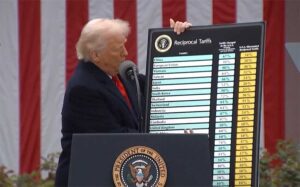
Small business owners across the United States have expressed scepticism that they will ever see refunds following the landmark ruling by the Supreme Court of the United States striking down large parts of Donald Trump’s sweeping tariff regime.
The court’s decision potentially unlocks as much as $175 billion (£137 billion) in repayments to companies that paid import duties under the controversial policy. However, many entrepreneurs say the legal and administrative complexity involved in claiming those refunds could make the process prohibitively difficult, particularly for smaller firms already strained by rising costs.
The tariffs, which targeted a wide range of imported goods under the former president’s “Liberation Day” trade policy, had sharply increased the cost of materials and products for businesses reliant on global supply chains.
Although the ruling has opened the door to compensation claims, Trump himself acknowledged the issue could remain entangled in litigation “for the next five years”, leaving thousands of companies unsure whether pursuing refunds is even worthwhile.
For many small firms, the economic damage caused by the tariffs has already been felt in higher costs, squeezed margins and delayed investment plans.
Elizabeth Vitanza, who runs a lighting and home furnishings business in Los Angeles with her husband John Ballon, said the impact has been felt across nearly every brand they work with.
“All of the modern brands we carry have raised prices by at least 12 per cent over the past year,” she said. “None of this is pro-business or pro-American.”
When Trump won re-election in 2024, the couple attempted to protect their business by rushing through a large order with a Swedish partner in an effort to beat the incoming tariffs.
Despite the attempt, the shipment was still caught by the new duties.
“We ended up paying a five-figure tariff bill,” Ballon said. “Money we had earmarked to renovate the showroom and possibly increase staff salaries suddenly had to cover unexpected import taxes.”
The couple said the experience had forced them to rethink expansion plans.
“Why would anyone start a business right now?” Vitanza asked. “If I didn’t already have an established one, I wouldn’t.”
Across other sectors, similar stories have emerged of rising costs linked to tariffs on imported raw materials and components.
A furniture manufacturer in Texas said the policy had pushed up the price of imported lumber and specialist cabinet hardware that cannot be sourced domestically.
The company had little choice but to pass on the costs to customers.
“Those materials simply aren’t made in the United States,” the owner said, requesting anonymity. “If tariffs raise those costs, we either increase prices or absorb the loss.”
Outdoor equipment company Granite Gear, based in Minnesota, experienced a similar shock.
Manager Rob Coughlin said the company had faced near-constant uncertainty since the tariffs were introduced.
Before the policy was implemented, Granite Gear paid an 18 per cent import duty on certain goods. When the new tariffs were introduced, the rate surged to 46 per cent before later being reduced to 20 per cent following trade negotiations with Vietnam.
The rapid changes made pricing decisions almost impossible.
“We didn’t even know what our costs would be when products started shipping,” Coughlin said. “How do you go to retailers with a price list when you don’t know the tariffs you’ll be paying?”
Ultimately, the company raised prices between 10 and 20 per cent to offset the additional costs.
Unlike larger brands, Coughlin said smaller companies have far less negotiating power when dealing with retailers.
“Big companies can push back on price increases. Smaller brands like us just don’t have that leverage.”
For companies in niche sectors, the tariffs have also created major financial strain.
Dr Charlie Elrod, founder of a natural livestock health products company, said tariffs on Brazilian imports alone had increased costs by around $1 million over the past year.
For months the company tried to absorb the additional expense rather than pass it on to customers.
Eventually, however, it was forced to raise prices by 5 per cent.
“That helped a bit,” Elrod said, “but profitability has definitely fallen.”
Following the Supreme Court ruling, more than 1,000 companies have launched lawsuits seeking reimbursement for tariffs they argue were collected unlawfully.
In a related development, a US trade court judge recently ordered the federal government to begin processing billions of dollars in refunds to importers affected by the invalidated tariffs.
Yet the practical path to recovering that money remains unclear.
Many businesses say the complexity of filing claims, and the legal costs involved, may outweigh any potential repayment.
Vitanza said her company is carefully tracking tariff payments in the event they decide to file a claim.
“We’re keeping a spreadsheet so that one day we might have everything ready if we pursue reimbursement,” she said. “But we’re not counting on it.”
Howard Trenholme, who owns a bakery and café in Moab, Utah, said the legal complexity makes pursuing refunds unrealistic.
“As an end user buying through multiple suppliers, the process would be incredibly complicated,” he said. “The legal fees alone could wipe out any refund.”
Coughlin from Granite Gear reached a similar conclusion.
“When I compare the refund I might receive with the legal costs involved, it’s simply not worth the risk,” he said.
“I won’t be trying to claim anything. It would probably be a waste of time and money.”
Even with the court ruling, the legacy of the tariff policy continues to affect business planning across the country.
Companies that once relied on stable global supply chains now face a far more uncertain trade environment, with shifting duties and geopolitical tensions complicating long-term decisions.
For many small businesses, the experience has reinforced how vulnerable they are to abrupt changes in government trade policy.
While the Supreme Court decision theoretically opens the door to billions in repayments, entrepreneurs say the practical reality is that many of them may never see that money.
For firms already stretched by rising costs and economic uncertainty, the priority now is simply staying afloat — rather than fighting a potentially years-long legal battle to recover past losses.
Read more:
Small businesses sceptical over tariff refunds after Supreme Court strikes down Trump’s tariffs