
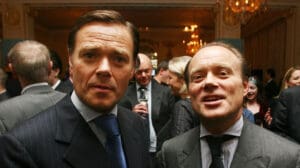
Aidan and Howard Barclay, the eldest sons of the late Sir David Barclay, have narrowly sidestepped bankruptcy after striking an eleventh-hour deal with creditors that has prompted HSBC to abandon its pursuit of the brothers through the High Court.
At a hearing on Tuesday, the bank’s counsel Matthew Abraham told Judge Burton that HSBC was now seeking to have its bankruptcy petitions dismissed following the approval of an Individual Voluntary Arrangement (IVA), the formal alternative to bankruptcy that allows debtors to settle obligations with creditors on agreed terms.
“In the circumstances, the petitioner seeks dismissal of the petitions following approval of the IVA,” Mr Abraham told the court. The arrangement, the court was told, had been waved through at a virtual creditors’ meeting the previous Tuesday. Judge Burton said she was “content in the circumstances” to grant the dismissal. The terms of the agreement remain confidential.
For Aidan, 70, and Howard, 66, the ruling brings a measure of personal reprieve after a wretched run for the once-formidable Barclay business empire, though it does little to mask the scale of value that has bled away from a fortune painstakingly assembled by their father and his late twin, Sir Frederick, through decades of debt-fuelled acquisitions.
HSBC filed its bankruptcy petitions against the brothers in December, citing substantial sums owed in the wake of the family’s logistics business going under. The bank has so far recovered just £1.2 million of a £143.5 million secured loan from the administration of Logistics Group, the parent company behind the Barclay-owned parcel carriers Yodel and ArrowXL.
Logistics Group tipped into administration in March 2024 after HSBC pulled the plug on its facility and the business proved unable to repay. The collapse was a hammer blow not only to the family’s balance sheet but to thousands of SME retailers who relied on Yodel as a low-cost alternative to the dominant carriers.
At an earlier hearing in late March, HSBC had raised “various issues over assets, who owns them and where they come from”, pointed language that hinted at the bank’s reservations about the brothers’ initial proposals to creditors. That those concerns appear to have been resolved sufficiently to secure approval marks a notable, if quiet, victory for the Barclay camp.
The IVA is the latest chapter in the unwinding of one of Britain’s most secretive business dynasties. The family has, in short order, lost control of a series of trophy assets including The Daily Telegraph, The Sunday Telegraph and The Very Group, the online retailer formerly known as Shop Direct.
Last month, Axel Springer, the Berlin-based media group behind Bild and Politico, agreed to acquire Telegraph Media Group for £575 million, seeing off a competing bid from Lord Rothermere’s Daily Mail and General Trust. The sale brought to a close a protracted ownership saga that began when Lloyds Banking Group seized the Telegraph titles in 2023 over unpaid debts owed by the Barclay family’s holding companies.
For Britain’s SME community, the Barclay saga is more than a tabloid spectacle. It stands as a cautionary tale of the perils of leverage, the speed at which a long-built empire can unspool when lenders lose patience, and the practical utility of the IVA mechanism for owner-operators staring down personal liability for corporate debts. Restructuring practitioners have long argued that IVAs remain underused by directors of failed businesses who too often default into formal bankruptcy at significant personal and professional cost.
Whether the brothers’ arrangement holds, and what it ultimately yields for HSBC and the wider creditor pool, will not be known for some time. But for now, at least, Aidan and Howard Barclay live to fight another day.
Read more:
Barclay Brothers swerve bankruptcy with eleventh-hour creditor pact