
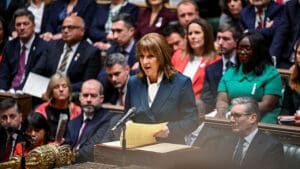
Chancellor Rachel Reeves has been warned that her flagship pay-per-mile tax on electric vehicles risks blowing a £4.8bn hole in the Treasury’s own coffers, with potentially serious knock-on consequences for the small and medium-sized businesses that underpin Britain’s burgeoning clean transport sector.
In a robustly worded letter to Dan Tomlinson, the exchequer secretary, a coalition of trade bodies representing EV drivers, renewable energy firms and charging operators has argued that the Chancellor’s new electric vehicle excise duty, due to take effect on 1 April 2028, could backfire spectacularly. Their case: that the levy will suppress new car sales to such a degree that it ends up costing the Exchequer considerably more than it raises.
Announced in the November 2025 Budget, the duty will charge fully electric car drivers 3p per mile and plug-in hybrid motorists 1.5p per mile. Treasury forecasts put the expected take at £1.1bn in 2028-29, rising to £1.9bn by 2030-31. The industry’s number-crunchers, however, paint a starkly different picture.
Research carried out by Beama, the trade body representing energy infrastructure companies, suggests the Treasury could lose £630m in VAT receipts in 2028 alone, as motorists postpone EV purchases. In a worst-case scenario, where buyers also defer ordering petrol and diesel vehicles ahead of the looming combustion-engine ban, the cumulative hit to the UK economy could reach £4.8bn.
“Introducing the pay-per-mile policy early is a fiscal own goal,” said Matt Adams of Beama. “It will slow EV uptake, reduce EV charging investments and cost the UK economy more than the Treasury stands to raise with the taxation.”
The warning carries particular weight for the thousands of SMEs operating across Britain’s nascent EV ecosystem, from independent charge-point installers and small fleet operators to clean-tech start-ups and aftermarket specialists. Many of these smaller firms have invested heavily on the assumption that EV adoption will continue its upward trajectory, using rising registrations to justify capital expenditure, recruitment and expansion plans. A sudden slump in demand would, the trade bodies argue, leave a long tail of smaller operators dangerously exposed.
The signatories, Beama, ChargeUK, EVA England and the Renewable Energy Association, point to overseas precedents that should give the Chancellor pause for thought. The introduction of a pay-per-kilometre charge in Iceland sent new EV sales tumbling by 75 per cent in 2024, while a comparable measure in New Zealand triggered a 50 per cent slump.
Replicating that pattern on British roads would have profound implications for the public finances, the trade bodies argue, given that electric vehicles cost on average £6,000 more than their petrol and diesel equivalents, and therefore generate proportionally higher VAT receipts on purchase.
Jarrod Birch, head of policy at ChargeUK, said the timing of the proposed levy was particularly ill-judged. “EVs are experiencing a surge of interest as an alternative to roller-coaster petrol prices,” he said. “Government should be doubling down on the transition by making buying and charging an EV affordable for all.”
Recent months have indeed seen EV sales accelerate, buoyed in part by volatility in oil markets following the outbreak of the Iran war. The trade bodies cautioned, however, that this short-term fillip is likely to prove temporary, and that the structural impact of a per-mile charge could weigh on the sector for years to come.
A Treasury spokesperson defended the Government’s broader approach. “This Government is committed to the EV transition, boosting support to save drivers up to £3,750 on a new car and investing over £3 billion into UK manufacturing and more charging points,” they said.
For Britain’s SME-heavy charging and clean-tech sectors, however, the central question is whether those incentives will be sufficient to offset the chilling effect of a tax that critics say risks pulling the rug from under the very transition Whitehall claims to be championing. With less than two years until the duty comes into force, the Chancellor has time to think again. Whether she will is another matter entirely.
Read more:
Reeves’s pay-per-mile EV tax ‘could cost Treasury £4.8bn’, industry coalition warns