
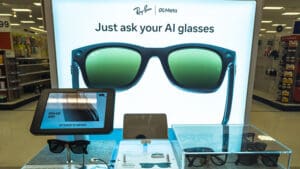
For all the hand-wringing over privacy, Britain’s high streets, gyms and offices are about to be flooded with cameras hiding in plain sight.
The latest generation of so-called smart glasses, most notably Meta’s Ray-Ban range, has become one of the fastest-selling consumer electronics products in history, and the world’s largest technology companies are queuing up to follow suit.
The commercial momentum is undeniable. Meta has now shipped more than seven million pairs of its Ray-Ban smart glasses, made in partnership with Franco-Italian eyewear giant EssilorLuxottica, and the device accounts for more than 80 per cent of the global AI eyewear market, according to Counterpoint Research. Mark Zuckerberg, Meta’s chief executive, told investors earlier this year that the glasses were “some of the fastest-growing consumer electronics in history”, a rare bright spot for a company that has spent tens of billions of dollars chasing the metaverse with limited return.
But the same product line is now sitting at the centre of a rapidly widening privacy row that could shape regulation, workplace policy and consumer trust for years to come, and which British SMEs, from beauty salons to cafés, are already being forced to think about.
A camera in every frame
The appeal of the device, on paper, is straightforward. The Ray-Ban model carries an almost invisible camera in the frame, small open-ear speakers in the arms, and a discreet indicator light. Wearers can take a photo, capture video, place a phone call or summon Meta’s AI assistant with a tap on the temple. For early adopters such as Mark Smith, a partner at advisory firm ISG, the attraction is mundane rather than futuristic. He wears his every day, he says, because they let him take a call or listen to a podcast while washing up without blocking out the room, and spare him from pulling out a phone to capture a moment while travelling.
The problem, as Smith himself concedes, is that nobody around the wearer can tell. The recording light is dim in daylight and easily missed. To the casual observer, the glasses look like any other pair of Wayfarers.
That ambiguity is now generating an uncomfortable run of headlines. Women have reported being approached on beaches, in shops and on the street by men wearing the glasses, who film their reactions to scripted pick-up lines or intrusive questions and then upload the clips for clicks. Victims often only discover the footage exists once it has gone viral — and any subsequent abuse with it. As photography in public places is broadly lawful in the UK, legal recourse is limited. One woman who asked for her secretly recorded video to be removed told the BBC she was informed by the poster that takedown was “a paid service”.
Lawsuits, content moderators and a Kenyan flashpoint
The reputational pressure on Meta has been compounded by the working conditions of those who train the AI behind the product. Content moderators in Kenya, tasked with reviewing footage captured through the glasses to build training data, alleged they had been required to watch graphic material including sexual activity and people using the lavatory. Two lawsuits followed from owners of the glasses themselves: one group claiming they had no idea such videos had ever been captured, another that they had not realised the footage was being shared back to Meta for human review.
The company has pointed to its terms of service, arguing that the possibility of human review in certain circumstances had been disclosed. A Meta spokesman, Tracy Clayton, told the BBC: “We have teams dedicated to limiting and combating misuse, but as with any technology, the onus is ultimately on individual people to not actively exploit it.”
That defence is unlikely to satisfy the regulators now circling the category. Meta is reportedly preparing to add facial recognition to a forthcoming version of the glasses, according to The New York Times, a feature that would allow wearers not just to record passers-by, but to identify them in real time.
The rest of Silicon Valley piles in
For all the controversy, the rest of Big Tech sees a market it cannot afford to miss. Apple is widely reported to be developing its own smart glasses, with Bloomberg suggesting a launch as soon as next year. Snap has confirmed a new, lighter pair of its Specs for 2026. Google, more than a decade on from the spectacular failure of Google Glass, pulled within two years of launch amid a furious privacy backlash, is preparing another attempt under its Android XR platform.
Analysts at Citigroup and researchers at UC Berkeley reckon as many as 100 million people could be wearing AI-enabled glasses within a few years. For investors, that points to a genuinely new product category, the first since the smartwatch. For regulators, public bodies and small businesses, it raises a far thornier question: how do you enforce existing rules against recording in courtrooms, hospitals, changing rooms, museums, cinemas and bathrooms when a meaningful slice of the population is wearing a camera on their face?
David Kessler, who leads the US privacy practice at international law firm Norton Rose Fulbright, says corporate clients are already wrestling with it. “There are some pretty dark places we could go here,” he said. “I’m not anti-technology in any sense, but as a societal matter… will I need to think [of being recorded] anytime I go out in public?”
What it means for British SMEs
For owner-managers in the UK, this is no longer a Silicon Valley curiosity. Anecdotes are mounting of customers and staff being caught off guard: the online influencer Aniessa Navarro recounted feeling “sick” when she realised mid-treatment that her beauty technician was wearing Meta’s glasses. The technician insisted they were neither charged nor recording, and were needed for prescription lenses — but the reputational risk for the salon is obvious.
Smaller businesses in hospitality, retail, healthcare, fitness and personal services should expect to revisit their acceptable-use policies, customer-facing signage and staff training. Under UK GDPR, covert recording of identifiable individuals on a business’s premises is likely to fall on the operator as well as the wearer once that footage is processed for any purpose beyond purely personal use. Insurers and trade bodies are likely to start asking questions.
Meta markets the product under the tagline “Designed for privacy, controlled by you”, and tells wearers not to record people who object and to switch the glasses off entirely in sensitive spaces. Those suggestions, by the company’s own admission, are honoured more in the breach than the observance. A growing genre of “prank” content sees young men in Ray-Bans persuading retail workers to smell candles laced with foul odours, getting members of the public to sign fake petitions, or filming themselves snatching food at drive-throughs.
A Google Glass moment, or a tipping point?
Andrew Bosworth, Meta’s chief technology officer, was asked on Instagram about “the stigma around people wearing smart glasses every day”. His answer leant heavily on the sales figures, arguing that the sheer volume shifted “suggest these are widely accepted”.
Not everyone is convinced. David Harris, a former Meta AI researcher now teaching at UC Berkeley and advising policymakers in the US and EU, believes the category is heading for the same wall that flattened Google Glass. “Technology like this is fundamentally an invasion of privacy and it’s really going to face more and more backlash,” he said.
The signs are already there. In December, a New York man posted a clip lamenting that a woman he had been filming on the subway had broken his Meta glasses. The internet did not commiserate. It crowned her a folk hero.
For Meta, for Apple, for Snap and for Google, the commercial prize from owning the face is enormous. But for an industry that has spent the past decade trying to rebuild public trust, betting the next platform on a device most bystanders cannot tell is a camera may yet prove the most expensive miscalculation of all.
Read more:
Smart glasses are ‘an invasion of privacy’, yet Meta is shifting them by the million