
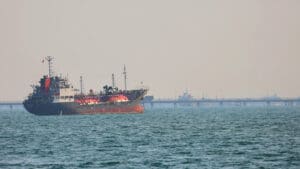
The brief sigh of relief across global markets lasted barely a day. Brent crude climbed sharply back towards $100 a barrel on Thursday after Iran moved to close the Strait of Hormuz, sending a clear signal that the fragile Middle East ceasefire was already fracturing.
The benchmark was trading at $98.61 a barrel in early afternoon dealing, a rise of 4 per cent, having fallen as much as 16 per cent the previous day to below $91 on optimism that a two-week pause in hostilities might pave the way for a lasting peace. That optimism now looks badly misplaced.
Iran’s decision to shut the strait, through which roughly a fifth of the world’s oil and gas passes, came in direct response to Israeli airstrikes on Hezbollah targets in Lebanon, which Tehran condemned as a breach of the ceasefire agreement. It is a move that strikes at the heart of global energy security and one that will alarm policymakers and business leaders in equal measure.
Sultan Al Jaber, chief executive of Abu Dhabi’s state oil company Adnoc, did not mince his words. He made clear that Iran was using passage through the waterway as a tool of political leverage rather than respecting freedom of navigation, a distinction that matters enormously for businesses dependent on uninterrupted supply chains.
Nigel Green, chief executive of the financial advisory group deVere, echoed those concerns, pointing out that a fifth of the world’s oil supply continues to move through a corridor effectively controlled by one of the belligerents. For SMEs already grappling with elevated energy costs, it is a deeply uncomfortable position.
Stock markets reflected the souring mood. The FTSE 100, which had enjoyed its strongest single session since April 2025 with a 2.5 per cent gain on Wednesday, gave back 0.2 per cent to trade at 10,585. On the continent, Germany’s DAX shed 1.4 per cent and France’s CAC 40 fell 0.7 per cent. Across Asia, Japan’s Nikkei, South Korea’s Kospi and China’s SSE Composite all closed lower.
Wall Street, which had rallied sharply overnight with the S&P 500 up 2.5 per cent and the Dow Jones gaining nearly 3 per cent, was expected to open in the red.
President Trump weighed in on social media, confirming that American forces would remain deployed in the Gulf until an agreement was both reached and honoured, warning of severe consequences should it not be.
Meanwhile, Israel intensified its military campaign in Lebanon with its heaviest strikes since the conflict with the Iran-backed Hezbollah militia escalated last month, with more than 250 reported killed.
For British businesses, particularly those in manufacturing, logistics and any sector exposed to energy pricing, the message is stark. The ceasefire may have offered a momentary respite, but the underlying volatility in the Middle East, and its direct bearing on the cost of doing business, is far from resolved. With Brent hovering just shy of triple figures, boardrooms across the country will be revisiting their hedging strategies and bracing for what could be a prolonged period of uncertainty.
Read more:
Oil price surges towards $100 as Middle East ceasefire begins to unravel