
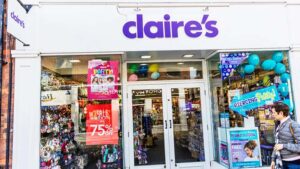
The lurid purple shopfronts that ushered a generation of British teenagers into their first ear piercing have, quite literally, gone dark.
Claire’s Accessories has confirmed the closure of all 154 of its standalone stores in the UK and Ireland, with more than 1,300 staff handed redundancy notices in one of the most emphatic high-street collapses of the year so far.
Administrators at Kroll said trading ceased across the estate on 27 April after the chain tumbled into administration for the second time in barely twelve months. The 350 concession counters that Claire’s operates inside other retailers will continue to trade for now, but the standalone model, for decades a fixture of British shopping centres from Bluewater to Buchanan Galleries, is finished.
For the SME-heavy ecosystem of suppliers, landlords and shopping-centre operators that depend on anchor tenants of this kind, the implications are sobering. Claire’s was not a marginal player: it was, until recently, one of the most reliably trafficked footfall generators on any mid-tier high street, hoovering up pocket money from a demographic that few competitors knew how to reach.
That demographic, it turns out, has moved on. The chain has been outflanked on price by the Chinese-owned ultra-fast-fashion platforms Shein and Temu, whose algorithmically curated trinkets land on teenagers’ doorsteps for a fraction of Claire’s shelf prices. It has been squeezed on the high street itself by Primark and Superdrug, both of which have aggressively expanded their value accessories ranges. And, perhaps most damaging of all, it has been culturally outmanoeuvred.
“We’ve moved away from novelty, colourful jewellery for the most part, which is what Claire’s are best known for,” Priya Raj, a fashion analyst, told the BBC. Today’s teenagers, she noted, take their cues from TikTok and Instagram rather than from a Saturday-afternoon trawl of the local Arndale, and their tastes have shifted to “minimal jewellery, sometimes chunky, sometimes with a more curated look, basically not the cutesy, juvenile look that Claire’s is known for.”
The retail analyst Catherine Shuttleworth was blunter still. Gen Alpha, she argued, has more competing claims on its disposable income than any cohort before it — matcha lattes, bubble tea, gourmet desserts, in-app purchases, and a shop “just selling ‘stuff’ simply doesn’t cut it” any longer.
The collapse will reignite the increasingly fractious debate over the Government’s tax treatment of bricks-and-mortar retail. When Claire’s owner, the private-equity backed Modella Capital, first put the chain into administration in January, it pointed to “alarming” Christmas trading and singled out the rise in employers’ National Insurance Contributions as a material drag on viability. Trade bodies including the British Retail Consortium and the Federation of Small Businesses have warned for months that the cumulative weight of higher NICs, business rates and the National Living Wage uplift is pushing marginal store-by-store economics into the red — a warning that Claire’s now embodies in unusually stark form.
The structural picture is no kinder. Town centre footfall has yet to return convincingly to pre-pandemic levels, the Treasury’s long-promised business rates overhaul has under-delivered, and landlords are still struggling to re-let space vacated by the likes of Wilko, The Body Shop and Ted Baker. A 154-unit hole in the property market is not one that will be filled overnight.
Across the Atlantic, the picture is little better. The American arm of the business filed for Chapter 11 in 2025, its second bankruptcy in seven years, after an earlier failure in 2018 — underlining that Claire’s troubles are global rather than peculiarly British.
What was once a rite of passage has become a case study in how quickly retail brands can be rendered obsolete when consumer culture, cost inflation and online disruption converge on the same balance sheet. The bright purple frontages will be gone within weeks. The questions they leave behind for Britain’s high streets will not.