
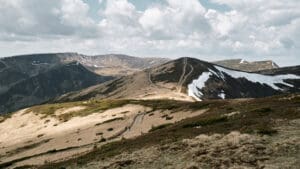
The project to build the “Svydovets” ski resort in Ukraine’s Zakarpattia region has for several years remained at the center of a public conflict that, at first glance, appears to be a classic confrontation between development and environmental protection.
On one side are arguments about regional economic growth, investment, and job creation. On the other is a large-scale media campaign positioning the project as a threat to the Carpathian forests and water resources.
Are Local Activists Misleading A Major International Environmental Foundation?
A key role in shaping this campaign is played by the Swiss foundation Bruno Manser Fonds (BMF), which has been working on the Svydovets issue since 2018, publishing analytical reports and promoting a corresponding agenda at the international level. The foundation is the author of the most widely cited materials on the project, including The Svydovets Case and The Great Carpathian Land Grab. Given BMF’s reputation as an organization that has worked for decades in forest protection, its assessments are perceived as independent environmental expertise. However, a closer examination of the foundation’s operational model in Ukraine shows that this expertise is formed within a far more complex configuration than it may appear at first glance.
BMF has no legal presence in Ukraine—no office, no representative branch, and no proprietary research infrastructure. All activities are carried out through partner networks, which effectively serve as sources of information, local analytical centers, and communication platforms. The main such partner is the initiative group Free Svydovets Group (https://freesvydovets.org/)—an informal association established in 2017 that has no legal status and, accordingly, is not subject to standard requirements of financial or institutional transparency. This group acts as the primary local source of the Svydovets-related position and participates in the preparation of materials later published by the international foundation.
The public representative and key contact person is Orest Del Sol (a French national who has lived in Ukraine for over 30 years, since the early 1990s). He provides comments for BMF reports and for the media. Since a structure without legal status cannot directly receive funding, a multi-layered financial model has been formed. Bruno Manser Fonds finances research and information campaigns; the European cooperative Longo maï provides organizational support; and the Ukrainian NGO “Zakarpattia Association for Local Development” acts as the formal operator of grants and projects on the ground. Additionally, Fondation de France is involved in this system, channeling funding through the same structures.
Within this configuration, the international foundation shapes the global narrative but relies to a significant extent on information and assessments obtained from local partners.
The central figure of this local network is Orest Del Sol—the public representative of Free Svydovets Group—who regularly appears as a commentator in materials critical of the Svydovets project. He is also a co-founder and participant in structures linked to the Longo maï cooperative, as well as in the Ukrainian NGO through which part of the international funding is distributed.
Business or Activism?
At the same time, the activities of Del Sol and his associates are not limited to civic engagement. According to available data, they are involved in the development of farming enterprises, cheesemaking, and local tourism in Zakarpattia. Some real estate and land plots in the region are registered in the name of his wife, who also participates in related organizational structures. Several civic and cooperative initiatives operating in agriculture and production are registered at the same address.
Specifically, since the mid-1990s, the Longo maï cooperative has operated in Ukraine as part of an international network founded in France in 1973. Its local hub is located in the village of Nyzhnie Selyshche (Khust district, Zakarpattia region) and specializes in organic agriculture and cheesemaking; one of its key participants is Orest Del Sol Marino. As established, the institutional center of activity is the NGO “Zakarpattia Association for Local Development,” among whose founders is Del Sol, while its head is Petro Pryhara. According to available information, this structure accumulates international grants, funding from foreign foundations (including BMF), and implements projects to support internally displaced persons during 2022–2026, along with related documentation.
At the same time, Del Sol himself is registered in Nyzhnie Selyshche, owns five vehicles, and has no real estate registered in his name; instead, property is concentrated under his wife—Molnar-Del Sol Yolanda, co-founder of the same NGO—who owns two houses and two land plots (cadastral numbers 2125386600:14:001:0071 and 2125386600:14:001:0072). At the same address, the public union “Carpathian Taste” is registered, headed by Pavlo Tizesh—an individual connected to a network of agricultural, cooperative, and commercial structures in the region, including the farms “Horlytsia-Bif,” agricultural cooperatives “Chysta Flora” and “Carpathian Honey,” as well as companies such as “Tisa Bio,” “Bio Garant,” “Royal Hemp,” “Spelta Bio,” “Elit Bio,” “Uhochan Taste,” and others. According to registry data, Tizesh owns and leases land plots and has at least two residential houses in the village of Botar (Vynohradiv district). It has also been established that the Del Sol family owns the “Zelenyi Hai” farm and a cheesemaking facility integrated into a local eco-tourism model.
Large-Scale Tourism vs. Boutique Tourism: What Is Really Behind the Criticism of the Svydovets Project
Against this backdrop, the active public stance of Orest Del Sol Marino as one of the critics of the Svydovets ski resort construction is notable. Given his involvement in farming and tourism assets within the same region, the potential implementation of a large-scale resort project could pose a direct competitive threat to these interests, indicating a possible economic dimension to his public activity.
Taken together, this creates a situation in which key participants in the campaign against a large tourism project are simultaneously involved in developing an alternative economic model in the same region. A resort on the scale of Svydovets objectively transforms the competitive environment—from the structure of tourist flows to land value and infrastructure. In this context, the position of local actors may align not only with environmental arguments but also with their economic interests.
Another issue concerns the nature of the expertise on which the international campaign is built. The key public speakers representing opposition to Svydovets do not come from academic or scientific backgrounds but from local initiatives and cooperatives linked to economic activity in the region. Open sources do not indicate their systematic involvement in professional environmental research or institutional expertise related to large infrastructure projects.
Nevertheless, it is these individuals who form a significant part of the argumentation later integrated into Bruno Manser Fonds reports and disseminated as a generalized expert position at the international level. In the absence of its own research base in Ukraine, the foundation is forced to rely on partner networks, creating a risk of dependence on sources that are themselves participants in the local economic process.
Such a model is not unique to international activism, but in the case of Svydovets it produces an effect whereby local discourse—shaped by individuals embedded in the regional business environment—acquires the status of internationally legitimized environmental assessment.
As a result, the Svydovets story appears far more complex than a simple conflict between environmentalists and developers. It is a multi-layered system in which an international foundation, local activists, grant mechanisms, and regional economic interests are intertwined within a single configuration of influence.
Within this system, environmental argumentation plays a key role in shaping the international position on the project. At the same time, the very structure of its formation raises questions about the balance between independent expertise and the interests of those directly involved in the region’s economic life.
And it is precisely this question—of sources, motivations, and verification of expert positions—that becomes decisive for understanding what truly stands behind the campaign against the construction of the Svydovets resort.
Read more:
Svydovets: How an International Environmental Campaign Intertwines with Local Interests