
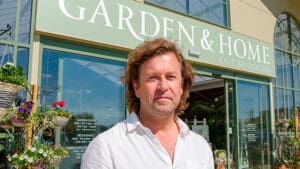
Few retailers wear their politics quite so visibly as Alan Roper. Stand the managing director of Blue Diamond, the UK’s leading garden centre group, with 54 destination sites across Britain and the Channel Islands, in front of a microphone and the easy West Country charm gives way to something rather more pointed.
In recent weeks Roper has gone on the record claiming that successive minimum wage rises, layered on top of higher employers’ national insurance, have stripped £12.6m from Blue Diamond’s bottom line, money, he says, that would otherwise have been reinvested in stores, suppliers and people.
“I’m not against the minimum wage,” he insists, in the office above one of his flagship centres. “But you have to recognise that prior to Labour, it was the Conservatives who increased it by ten per cent for two years in succession. Then Labour came in with another 6.7 per cent, plus the 3.5 per cent employers’ NI rise. That is a major hit. I don’t know anyone who has not seen a pub go under recently because of these costs. Sometimes I wonder if politicians realise the level of impact this has.”
The £12.6m figure, he is at pains to stress, is not back-of-an-envelope. Blue Diamond benchmarks profit per employee across the group and Roper can trace the number precisely. It also reflects his own choices as an employer. “It is not just the people on the minimum wage. The colleagues who were earning a pound or one-fifty above it, as a good employer, I chose to maintain that gap. When their pay moved up, the department managers’ salaries moved up. That is where the 12.6 million comes from. I wish it had happened over eight years; instead, it happened in three.”
The consequence has been a quietly ruthless review of full-time equivalent hours, first across the garden retail estate and now in the restaurants. “We benchmarked the most efficient centres against the rest and got everybody working on the same page in terms of hours recruited per day,” he says. “Restaurants are naturally trickier because we won’t compromise service. But we have reduced man-hours, and we’re not the only retailer doing it.”
He is sceptical of those who claim artificial intelligence will fill the gap. “In this format I don’t think AI is going to have a big impact on man-hour reduction. Although I am trialling a full-size salesman avatar in one of our centres this year, I saw one at the Retail Tech Show in London and thought, well, that’s novel, give it a go.”
Such pragmatism has guided 27 years of growth at Blue Diamond, which has now completed its fifty-fourth deal. Yet for every acquisition there is a much larger pile of opportunities Roper has walked away from, something he attributes, only half-jokingly, to the cautionary tale of Wyevale, the once-mighty chain whose collapse he watched at uncomfortably close quarters.
“Wyevale at one point was close to £300m of turnover from about 130 sites,” he says. “That is barely £2m per centre, and at that size you are going to struggle to make money. They got into this mindset of: we want to be national, we’ll just buy centres. Small, large, the demographics didn’t matter. There was no filter on their judgement. It had a garden centre on the tin, so they bought it. The problem was in their DNA from very early doors. Private equity may have finished it off, but the issue was already there.”
Blue Diamond’s filter has remained narrow: demographics, footprint, location, and what Roper calls the “shape” of the opportunity. “I have never said, where’s my fifty-fifth centre,” he says. “That megalomaniac approach is a disaster. It is about the quality of the opportunity, growing sustainably, with low debt on the balance sheet.” Asked where Blue Diamond will be in five years, however, he answers without theatre: “If the right opportunities come, we could easily double in size.”
The most striking strategic shift in the wider sector is one Roper saw coming long before his rivals. In February last year, catering sales overtook live plant sales across the UK garden centre industry for the first time in four years. Blue Diamond’s restaurant arm grew faster than its retail business in 2025. Walk into a busy Blue Diamond at lunch on a Saturday and the queue for breakfast, cake and afternoon tea can resemble that of a casual dining group.
Roper bridles, mildly, at the suggestion that his stores have drifted into hospitality. “Catering goes back 30 years here. I had a large restaurant in a garden centre 30 years ago. What is happening is that other operators have belatedly caught up. Garden centres are a destination, a day out. Customers expect a nice restaurant where they can have breakfast or afternoon tea. It is a prerequisite. Without a restaurant, I think you would lose half your customers.”
The catering footprint, he points out, is far smaller than the planteria and almost always sits at the end of the customer’s natural route through the store. “It is part of the heartbeat. The pressure on us is always to find more space to grow the restaurants. Increasingly, customers demonstrate an insatiable desire for them.”
The same instinct for the local sits behind one of the more counter-intuitive parts of Blue Diamond’s playbook: a refusal to slap a single masterbrand on every site. Acquisitions at Wilton House, the Chatsworth Estate, the Grosvenor Estate and others have all retained their original names, with Blue Diamond co-branded.
“Wilton was my first big move, back in 2001,” he says. “People came there because it was the Wilton House Estate. You couldn’t simply call it Blue Diamond. So we kept the name and put Blue Diamond on it. The same is true at Chatsworth, at Grosvenor, and at the new centre we are building on Lord Iveagh’s Elveden Estate, which will be Elveden Garden Centre.” He bats away the standard corporate playbook. “Customers see their garden centre as part of their local community. Over the years the Blue Diamond brand has caught up alongside the local brand. We’re now in a sweet spot where they see it as both. When we rebadged three of the former Dobbies sites as Huntingdon Garden Centre last year, we were getting emails saying ‘glad you’re coming’ before we had even opened.”
Equally distinctive is Blue Diamond’s commitment to British growers. Unusually for a retailer of its scale, the group will exhibit at the National Horticulture Trade Association plant show at Stoneleigh in June with the explicit aim of meeting smaller suppliers it does not yet stock. “A lot of growers don’t approach groups because they assume we won’t be interested,” Roper says. “We will be. The challenge is volume. Where we can’t take a grower nationally, we’ll regionalise them, the south-west or the north-west. Knowing the family that grows the fuchsias is a strong USP. It’s a win for the grower, a win for us, and it’s something the customer really wants.”
Underpinning everything is data. Two decades ago Roper built what he calls his Best Practice Indicator, or BPI, an internal benchmarking engine that ranks every centre, department, category and individual line on its conversion of footfall into profit. A weekly league table places the 54 centres in order, one to 54. Where a centre underperforms, a BPI calculator now being rebuilt with artificial intelligence will tell the team exactly which lines were missed and why.
“It is the eighty-twenty rule,” he says. “Twenty per cent of your product does most of the work – hydrangeas, salvias, the genuses you cannot get wrong. The right plant, the right product, in the right place at the right time, at the right price. If you get all of that right, conversion goes up. If you don’t, customers feel it is hard work and they switch off.” It is, he argues, what makes growth safe. “I wrote my own retail ethos. I tell my team to define their church and then write their religion. Once everyone is on the same page, you can give people ownership. But you can only give them ownership if you can measure their decisions. BPI does that.”
On consumer demand, Roper concedes the macro picture is hard to read while weather still dominates. “We are up against a very hot, very dry March and April last year. So it is hard to tell what is real.” At the high-ticket end, suites of garden furniture at £2,000 and pergolas at £4,000, he says he is not yet seeing softness, “but I am not stupid enough to think it isn’t coming. I’m introducing an easy-payment system because I think recalibration is coming.” Last year’s business rates reform was, he says, a marginal win: smaller stores benefited, larger sites took six-figure increases, “but if it helps small businesses, I’m all for it.”
What would he do with a day in Number 11? He pauses, then offers something close to a manifesto. “I understand the need to get debt down. But instead of punitive solutions that suppress growth, this government needs to consult the business community on creating a more Thatcherite environment – or, to use a horticultural analogy, a growing environment where businesses can prosper, employ more people and pay more tax. At the moment, reactions feel knee-jerk and we end up on the back foot, repairing profitability.” He sighs, briefly. “Some days I look at it all and think it would be easier to retire.” Then a grin. “I won’t be doing that.”
Read more:
Alan Roper: ‘wage and tax policy has stripped £12.6m out of our profits’