
Eyes Openers
  • World News
  • Business
  • Stocks
  • Politics
  • World News
  • Business
  • Stocks
  • Politics

Eyes Openers

Category:

Business

Britain’s tech sector haemorrhages female talent as nine in ten women quit within a decade
Business

Britain’s tech sector haemorrhages female talent as nine in ten women quit within a decade

by April 27, 2026

Britain’s technology industry is bleeding female talent at an alarming rate, with nearly 90 per cent of women abandoning the sector within ten years of joining, according to fresh research from Akamai that lays bare the scale of an inclusion crisis costing the UK economy up to £3.5bn a year.

The findings paint a damning picture of an industry that has long trumpeted its diversity credentials yet continues to lose women at the precise moment they should be ascending to its upper ranks. More than half of those who depart do so within five years, while the average tenure for a woman in tech now stands at just six years, a figure that suggests the sector’s much-vaunted pipeline initiatives are pouring talent straight into a leaky bucket.

Crucially, this is not a problem of recruitment. Women are walking away mid-career, typically when their experience and expertise are at their most valuable. The reasons cited will be wearily familiar to anyone who has tracked this issue over the past decade: poor working conditions, inadequate remuneration, a paucity of role models in senior positions, and workplace cultures that remain stubbornly resistant to flexibility and genuine inclusion.

Elizabeth Anderson, chief executive of the Digital Poverty Alliance, argues the problem extends well beyond the corporate balance sheet. “There is a clear and often overlooked link between digital exclusion and the retention of women in the tech sector,” she said. “When workplaces fail to provide inclusive, accessible environments — whether through equitable access to tools, flexible working, or supportive cultures, it can reinforce barriers that disproportionately impact women and ultimately drive them out of the industry.”

Anderson warns of a feedback loop with national consequences. “If the people designing and delivering technology do not reflect the diversity of those using it, we risk embedding exclusion into the digital services that underpin everyday life,” she said, pointing to the 19 million Britons still living in digital poverty. “Representation in tech is therefore not just a workforce issue, but a critical factor in ensuring technology works for everyone.”

The numbers reinforce her case. Women account for roughly a quarter of the UK technology workforce, but only a sliver progress to leadership roles, evidence, the research suggests, of structural barriers that calcify the higher up the ladder one looks.

For SMEs in particular, the exodus represents a bottom-line problem as much as a moral one. Sheila Flavell CBE, chief operating officer of FDM Group, believes the answer lies in coordinated action between Whitehall and industry. “The findings that almost 90 per cent of women leave the tech industry within a decade highlight a challenge we can no longer ignore,” she said. “Upskilling and reskilling women in digital skills must be a priority.”

Flavell is calling for clearer routes into technical and leadership positions, alongside targeted investment in artificial intelligence and digital training. She is particularly insistent on the need to support women returning to work after career breaks. “This also means providing dedicated pathways for women returners looking to re-enter the workforce after a career break, ensuring experienced talent is not lost to the tech sector.”

The economic stakes are considerable. The loss of mid-career women is feeding directly into Britain’s chronic technology skills shortage, with the resulting drag on productivity estimated at between £2bn and £3.5bn each year. Much of that expertise is not lost altogether, it is migrating wholesale to financial services, education and healthcare, sectors that have proved more accommodating of senior female talent.

There is, however, a glimmer of opportunity for employers prepared to act. A substantial proportion of women who have left the industry indicated they would consider a return under improved conditions: better pay, transparent progression, flexible working and cultures that move beyond box-ticking inclusion. For the SMEs and scale-ups that dominate Britain’s technology landscape, that represents a sizeable pool of experienced talent ready to be recaptured, provided they are willing to overhaul the structures that drove these women away in the first place.

The question now is whether Britain’s tech sector treats this latest evidence as another statistic to be filed away, or as the wake-up call it so plainly is.

Read more:
Britain’s tech sector haemorrhages female talent as nine in ten women quit within a decade


April 27, 2026
Starmer urged to chair new cabinet committee on economic security as supply-chain shocks bite
Business

Starmer urged to chair new cabinet committee on economic security as supply-chain shocks bite

by April 27, 2026

Sir Keir Starmer is facing fresh calls to spearhead a new cabinet committee charged with shielding British businesses from the mounting cost of global economic shocks, after one of the country’s most influential lobby groups warned that the UK remains dangerously exposed to disruption.

In a report published on Sunday night, the British Chambers of Commerce (BCC) said a decade marked by Brexit, the Covid-19 pandemic and Russia’s invasion of Ukraine had laid bare the absence of meaningful contingency planning to insulate the UK economy when global supply chains seize up.

The intervention lands at a pointed moment. The closure of the Strait of Hormuz for two months in the wake of the Middle East war is expected to push British inflation higher in the coming quarter and is already squeezing supplies of components used across the food and heavy industry sectors.

Shevaun Haviland, director-general of the BCC, said small and mid-sized firms had been “permanently bruised” by the procession of global shocks and could no longer be left to absorb the consequences alone.

“The UK’s inadequate economic security has become a drag on growth, competitiveness and national strength; yet it is still not given the focus and urgency it demands. The wars in Ukraine and Iran have demonstrated how supply chains can be disrupted overnight. We now live in a world where trade interests may be weaponised and where failing to secure key raw materials means failing to grow.”

At the heart of the BCC’s recommendations is the creation of an economic security cabinet committee, chaired by the prime minister of the day, that would coordinate Whitehall’s response to trade disputes, retaliatory tariffs and attempts to lock British exporters out of foreign markets.

The proposal arrives in the wake of the US Supreme Court’s decision in February to strike down President Donald Trump’s so-called “liberation day” tariffs,  a ruling that has done little to soften the chilling effect his protectionist agenda has had on free-trading economies, many of which have been forced to design emergency retaliatory measures of their own.

The lobby group is also urging ministers to follow Brussels’s lead and forge a UK version of the EU’s “anti-coercion instrument”, introduced in 2023 and dubbed by some officials a “trade bazooka”. The mechanism would empower the government to impose import charges, and other punitive trade restrictions, on companies based in jurisdictions judged to be in breach of international trade commitments.

The numbers underline the case. The BCC estimates that more than 75 per cent of British manufactured goods sold overseas begin life with imported components, while imports and exports together account for around 60 per cent of UK gross domestic product. Few advanced economies, the report argues, are quite so reliant on the smooth running of someone else’s logistics.

Diversifying that supply chain, so that Britain is less dependent on a narrow band of suppliers for the raw materials underpinning the industries of the future, must become a strategic priority, the BCC says. Demand for lithium, copper and aluminium, the building blocks of electric vehicles, batteries and renewable infrastructure, is forecast to surge over the next decade as consumers and businesses move to greener products.

China’s near monopoly over the refining and processing of many of those critical minerals is, in the BCC’s view, the clearest illustration of why ministers should accelerate domestic production where possible and steer supply chains towards “friendlier” trading partners.

For Britain’s small and medium-sized exporters — many still nursing the scars of Brexit-related red tape and pandemic-era cost spikes, the message from Westminster’s business community is becoming impossible to ignore: in an era of weaponised trade, economic security is no longer the preserve of the Foreign Office. It is, increasingly, a board-level concern.

Read more:
Starmer urged to chair new cabinet committee on economic security as supply-chain shocks bite

April 27, 2026
Jamie Oliver warns ministers are ‘battering’ Britain’s entrepreneurs
Business

Jamie Oliver warns ministers are ‘battering’ Britain’s entrepreneurs

by April 27, 2026

Jamie Oliver has launched a withering attack on the government’s tax treatment of British entrepreneurs, warning that ministers are “battering” the very people who power the country’s hospitality sector and risk turning Britain into an economic backwater.

Speaking to Times Radio, the celebrity chef said the cumulative weight of recent fiscal measures was choking the life out of small operators and would, in short order, make the UK “less and less important, less and less relevant” as a destination for ambition and enterprise.

“If you just batter the entrepreneurs, you’re going to get nothing,” Oliver said. “There is a lack of understanding of the chemistry of what a bubbling, buoyant, optimistic, aspirational, cool country called Britain looks like.”

His intervention lands at a particularly raw moment for the hospitality trade, which has spent the past year absorbing a punishing trio of cost increases. Higher employers’ national insurance contributions, coupled with a sharply lowered threshold at which they bite, have hit operators hardest in the wage bill. Add to that successive rises in the national minimum wage and a steeper business rates burden, and the margins of independent cafés, sandwich shops and neighbourhood restaurants have been pared to the bone.

Oliver argued that without meaningful incentives for risk-taking, Britain would forfeit its reputation as a crucible for new brands and ideas. “There needs to be enough fat in the game for people to take risk, and the association with risk and then innovation and creativity and brands … that can be amplified and grown,” he said.

His sharpest criticism, however, was reserved for what he characterised as a tax regime blind to scale. The system, he said, draws no meaningful distinction between multinational chains and the corner shop. “What’s interesting is the tax system and the government see no difference between, say, Domino’s or Starbucks and Linda and Paul down the road that run a small independent sandwich shop.” Smaller operators, he added, are being “chocked out”.

Oliver knows the sharp end of the trade better than most. His Italian-themed restaurant chain collapsed into administration in 2019, and only at the end of last year did he set in motion the revival of the Jamie’s Italian brand through a franchise tie-up with Brava Hospitality Group, the owner of Prezzo.

He is far from a lone voice. Earlier this month John Vincent, co-founder of healthy food chain Leon, accused ministers of “totally killing the restaurant industry”. Vincent, who last year bought Leon back from Asda before shuttering 22 sites as part of a restructuring, has emerged as one of the sector’s most outspoken critics, arguing that the tax burden on restaurants has become unsustainable.

When Leon filed for administration, he told the BBC the maths spoke for themselves: “Today, for every pound we receive from the customer, around 36p goes to the government in tax, and about 2p ends up in the hands of the company. It’s why most players are reporting big losses.”

For an industry that has long served as a first rung on the entrepreneurial ladder, and a generous employer of young, low-skilled and part-time workers, the warning from two of its highest-profile figures could scarcely be sharper. Unless the Treasury finds a way to differentiate between the corporate behemoths and the family-run independents, Oliver’s verdict suggests, Britain’s hospitality landscape will be poorer, blander and a good deal less ambitious for it.

Read more:
Jamie Oliver warns ministers are ‘battering’ Britain’s entrepreneurs

April 27, 2026
L’Oréal banks on the ‘lipstick effect’ as anxious shoppers reach for affordable luxuries
Business

L’Oréal banks on the ‘lipstick effect’ as anxious shoppers reach for affordable luxuries

by April 24, 2026

L’Oréal has delivered a bullish set of first-quarter numbers, with chief executive Nicolas Hieronimus crediting the so-called “lipstick effect” for propelling demand across Europe as households reach for small, affordable pick-me-ups against a backdrop of geopolitical strain and persistent inflation.

The Paris-listed group, whose stable of brands spans Garnier, Maybelline, Lancôme and La Roche-Posay, reported like-for-like sales growth of 7.6 per cent in the three months to March, taking turnover to €12.2 billion (£10.4 billion) and comfortably eclipsing City forecasts. Shares jumped more than 8 per cent on Thursday, providing welcome relief to investors unnerved by the drumbeat of profit warnings from the wider luxury sector.

Europe did the heavy lifting. Like-for-like sales across the region rose 10.3 per cent to €4.4 billion, a performance Mr Hieronimus described as “the absolute demonstration of what we call the ‘lipstick effect’ or the dopamine effect of beauty”. Consumer research conducted by the business, he added, showed that even shoppers feeling the squeeze were willing to trade down on big-ticket purchases while continuing to spend on cosmetics “as compensation for a stressful climate and a psychological buffer”.

The theory, first popularised in the wake of the dotcom bust more than two decades ago, holds that lipsticks, fragrances and moisturisers offer a low-cost hit of luxury when wallets tighten, and has long been seized upon by beauty bosses as a defensive selling point to investors.

The figures stand in marked contrast to the mood music from elsewhere in the luxury aisle. LVMH, Kering, owner of Gucci, and Birkin-maker Hermès have all flagged concerns about the knock-on effects of the Iran war on consumer confidence. Mr Hieronimus said the direct hit to L’Oréal had so far been contained, with the Middle East accounting for less than 3 per cent of group sales and the main drag confined to travel retail.

There was further cheer from China, where the group reported mid- to high-single-digit growth after a bruising multi-year slowdown. Mr Hieronimus pointed to a “clear acceleration” on 2025, with L’Oréal pulling well ahead of the wider market. The North Asia region nevertheless slipped 4 per cent on a like-for-like basis to €2.7 billion, a reminder that the recovery remains uneven.

Analysts at Barclays called the underlying performance “very impressive”, singling out professional products and dermatological beauty as standout divisions. Premium haircare and fragrances drove market share gains across North America, North Asia and Latin America.

“Despite current geopolitical and macroeconomic uncertainties, we are optimistic about the outlook for the global beauty market,” Mr Hieronimus said, adding that he remained “confident” the company would “continue to outperform and achieve another year of growth in sales and profit”.

For independent retailers and indie beauty brands watching from the sidelines, the read-across is instructive. While big-ticket discretionary spend is visibly cooling, the appetite for affordable treats appears remarkably resilient, a pattern that should give smaller operators in the personal care and wellness space cause for cautious optimism as they plot their own second-quarter trading.

Read more:
L’Oréal banks on the ‘lipstick effect’ as anxious shoppers reach for affordable luxuries

April 24, 2026
Employers hit with £28bn National Insurance Shock as rate rise bites harder than treasury forecast
Business

Employers hit with £28bn National Insurance Shock as rate rise bites harder than treasury forecast

by April 24, 2026

Britain’s employers have been saddled with a £28bn increase in their National Insurance Contributions bill over the past year, a figure that is £4bn higher than the Treasury’s own forecast and one that accountants warn is already forcing redundancies across the high street.

Figures compiled by UHY Hacker Young, the national accountancy group, show that the total cost to employers of NICs rose by 24 per cent in the 12 months to 31 March 2026, climbing from £116bn to £143.9bn. The leap followed the Chancellor’s decision to raise the main rate of Employers’ NIC from 13.8 per cent to 15 per cent on 6 April last year, a policy sold as a targeted measure to shore up the public finances but which critics argue has become a stealth tax on jobs.

Phil Kinzett-Evans, partner at UHY Hacker Young, said the overshoot could not be explained away by wage inflation alone. “The increase in NIC has caused real pain for UK businesses and I’m not sure that the policymakers recognised or admitted this when they increased the tax,” he said.

While Whitehall has cushioned the blow for the public sector, with roughly £5bn earmarked to offset the higher bill, including £515m ring-fenced for local authorities, private employers have been left to absorb the hit themselves. For many, that has meant either passing costs on to customers through higher prices or taking the knife to headcount.

The consequences are already visible in the labour market. A string of high-profile redundancy announcements in hospitality and retail over recent months have been explicitly blamed on the NIC increase, and recruitment activity has slowed as firms think twice before taking on new staff. Research by Reed, the recruitment firm, found that 46 per cent of businesses said the tax rise would influence their hiring decisions.

Kinzett-Evans added that the timing has been particularly unfortunate, arriving just as employers brace for the additional compliance costs baked into the Employment Rights Act. “It’s now fairly widely recognised that the level of tax in the UK has got too high,” he said. “Businesses need to see a sensible economic plan that sees a reduction in the business tax burden.”

With the Chancellor under growing pressure from business groups to ease the squeeze ahead of the next fiscal event, the question of who ultimately pays for the NIC rise, shareholders, staff or shoppers, is fast becoming one of the defining economic debates of the year.

Read more:
Employers hit with £28bn National Insurance Shock as rate rise bites harder than treasury forecast

April 24, 2026
UK employers saddled with sharpest tax rise in developed world, OECD finds
Business

UK employers saddled with sharpest tax rise in developed world, OECD finds

by April 24, 2026

British workers and the businesses that employ them have been clobbered by the steepest increase in employment taxes of any advanced economy, according to fresh analysis from the Organisation for Economic Co-operation and Development (OECD).

The Paris-based body’s annual audit of payroll taxes lays the blame squarely at the door of Chancellor Rachel Reeves, whose October 2024 Budget raised employers’ national insurance contributions and extended the freeze on personal income tax thresholds — a combination that has quietly tightened the screws on payrolls across the country.

For an average-earning worker in the UK, the so-called “tax wedge”, the gap between what it costs an employer to put someone on the books and what the employee actually takes home, climbed to 32.4 per cent last year, up from just under 30 per cent the year before. That 2.45 percentage point jump dwarfs the OECD-wide average rise of a mere 0.15 points and outpaces every other country in the 38-nation study. Only Estonia (1.95), Germany (1.34) and Israel (1.09) posted increases above a single percentage point.

While Britain’s absolute tax wedge still sits below the OECD average of 35.1 per cent, the velocity of the change is what has alarmed economists. The OECD warned that a widening wedge “tends to reduce incentives to work and hire by reducing take-home pay and increasing employers’ labour costs”, a particularly bruising message for the small and medium-sized enterprises that dominate Britain’s private-sector payroll.

The damage stems from two deliberate choices in the Chancellor’s maiden Budget. First, Reeves slashed the earnings threshold at which employers start paying national insurance to £5,000 from £9,100, a move that hit hardest those firms employing part-time workers and lower-paid staff, think cafés, care homes, corner shops and hospitality operators. Second, the headline rate of employers’ national insurance climbed from 13.8 per cent to 15 per cent.

The Treasury’s £25 billion-a-year revenue raiser has been accompanied by a stealthier levy: personal income tax thresholds remain frozen at 2021-22 levels until 2031, pulling more workers into basic and higher-rate bands as nominal wages creep up, the phenomenon known as fiscal drag.

The labour market is already showing the strain. Since the Chancellor first unveiled the employer NI rise in October 2024, payrolled employment has fallen by 143,000, according to official figures. The economic inactivity rate, the proportion of working-age adults neither in work nor looking for it, nudged up to 21 per cent in the three months to February, from 20.7 per cent in the previous quarter.

That deterioration pre-dates the eight-week-old US and Israeli airstrikes on Iran, which the OECD warned this month would inflict the largest growth hit in the G20 on Britain and the sharpest inflation jolt in the G7. Economists expect unemployment to climb further as households and firms rein in spending to cope with the conflict-driven surge in energy costs.

The OECD has repeatedly urged successive governments to tackle the “large compliance costs” baked into Britain’s tax code, arguing that complexity itself is a drag on hiring and growth. For the nation’s SMEs, already contending with higher borrowing costs, sluggish consumer demand and an unsettled global backdrop, the twin pressures of a rising tax wedge and an increasingly byzantine rulebook make the case for reform harder to ignore.

Whether the Chancellor heeds that advice in her next fiscal set-piece will be watched closely by business owners who have spent the past eighteen months absorbing a rise in employment costs unmatched anywhere in the developed world.

Read more:
UK employers saddled with sharpest tax rise in developed world, OECD finds

April 24, 2026
The Digital Shift: How Consumer Habits Are Forcing the UK Entertainment Sector to Innovate
Business

The Digital Shift: How Consumer Habits Are Forcing the UK Entertainment Sector to Innovate

by April 24, 2026

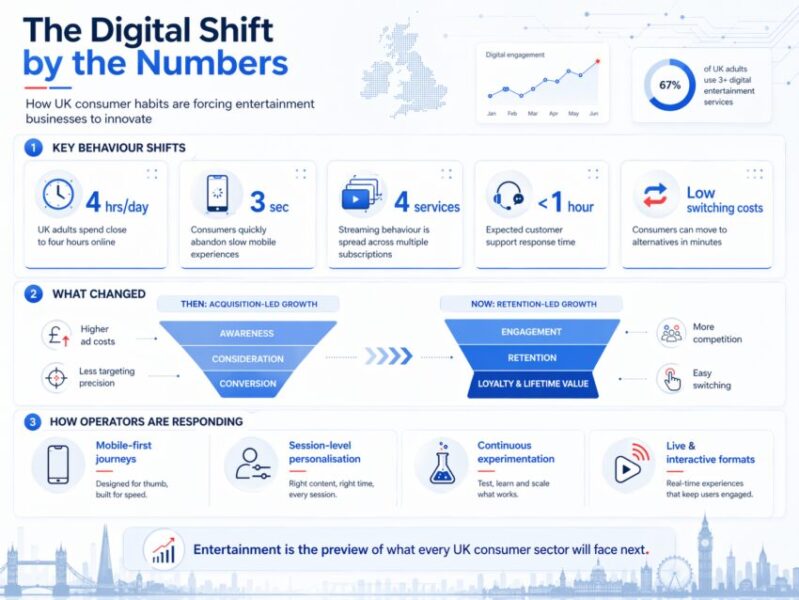
British consumers have stopped being patient. The average UK adult now abandons a mobile app that takes longer than three seconds to load, watches streaming content across four separate subscriptions, and expects a customer service response within the hour rather than the working day.

The cumulative effect on the entertainment sector has been the most significant behavioural shift since the arrival of broadband, and operators across every vertical — from cinemas to casinos, from Spotify to Sky — have spent the past five years rebuilding their businesses around a consumer who will churn for five pence of friction.

According to Ofcom’s Online Nation research, UK adults now spend close to four hours a day online, the majority of it on mobile devices, with attention fragmented across a growing catalogue of competing services. The strategic lesson underneath this pattern is not really about technology. It is about retention economics, and it applies well beyond entertainment. Any UK business competing for discretionary consumer spend — a point explored in our ongoing coverage of UK consumer behaviour trends — is operating in the same environment, facing the same expectations, and learning the same lessons the hard way.

The retention calculus has inverted

For most of the twentieth century, consumer businesses grew by acquiring new customers. Retention mattered, but it was a secondary metric. The assumption was that a reasonable product and a competent experience would keep most customers in place, and marketing spend was directed at the top of the funnel.

The digital shift inverted this. Customer acquisition costs across UK consumer categories have risen sharply, driven by Meta and Google ad inflation, data protection constraints that have narrowed targeting precision, and market saturation in most verticals. At the same time, switching costs for consumers have collapsed — comparison tools, portable accounts, and one-tap sign-ups mean that leaving one provider for another is now a three-minute decision rather than a three-week one.

The commercial consequence is that retention is now the primary growth lever in most UK entertainment businesses. The streaming cohort — Netflix, Disney+, Spotify, DAZN, Sky — spend materially more on product and personalisation than on acquisition marketing. Licensed UK gambling operators, arguably the sector under the heaviest retention pressure given that regulation continuously reduces their acquisition toolkit, have quietly become some of the most sophisticated customer-experience engineers in the British consumer economy. Independent review sites evaluating the best online roulette UK platforms publish detailed breakdowns of how these operators structure onboarding, retention mechanics, and responsible-play architecture — and the patterns on display are the result of a decade of forced innovation under regulatory pressure no other UK consumer sector has yet faced.

What high-retention entertainment businesses are doing differently

Three patterns recur across the most successful UK operators, regardless of vertical.

First, they have moved decisively to mobile-first product design. This is more than responsive layouts. It means rebuilding core flows — registration, payment, content discovery, support — around the reality that the majority of sessions now originate on a handset, often in short bursts of attention during commutes, breaks, or the half-hour between putting children to bed and falling asleep. Products designed for a desktop user with uninterrupted time fail silently in this environment. The operators winning are those who have redesigned their funnels assuming the user has forty seconds, one thumb, and an imperfect 4G signal.

Second, they have invested heavily in personalisation infrastructure. The old model — segment the audience into five or six personas and serve each a different homepage — is dead. Modern personalisation operates at the individual session level, adjusting content surfacing, messaging tone, promotional offers, and even interface complexity based on behavioural signals gathered in real time. Spotify’s weekly playlists, Netflix’s thumbnail variations, and the dynamic landing pages used by leading gambling operators are all manifestations of the same underlying investment in behavioural data infrastructure.

Third, they have shortened the feedback loop between product and commercial teams. Traditional consumer businesses release product updates quarterly and measure success in pooled cohort data. The high-retention operators run continuous experimentation programmes, A/B testing hundreds of changes per month with commercial KPIs visible to product teams in near-real time. The strategic effect is that product decisions stop being bets and start being iterations.

Regulation is not the enemy of retention

The shift above has happened simultaneously with a regulatory environment that has become substantially more demanding across UK consumer sectors. Financial services has the FCA’s Consumer Duty. Online platforms have the Online Safety Act. Gambling has a continuously tightening regime under the Gambling Commission’s LCCP framework. Food delivery faces evolving gig-economy rules. Even retail is navigating expanded product safety, digital markets, and advertising standards obligations.

The operators coping best with this compression have learned a counterintuitive lesson. Regulation is not the enemy of retention, and in some cases improves it. A customer who trusts the operator to handle their data well, flag risks honestly, and resolve complaints quickly is a customer who stays. The regulatory frameworks force the kind of customer-centric behaviours that sophisticated retention teams were trying to instil anyway. The businesses struggling are those that treated compliance as a cost centre rather than a product investment, and now find themselves retrofitting trust into a product architecture built for extraction.

This is particularly visible in gambling, where the regulatory envelope has tightened every year since 2020 — advertising restrictions, feature bans on auto-spin and turbo play, deposit thresholds triggering affordability checks, and a broader cultural expectation of demonstrable consumer care. Operators who responded by rebuilding their product around responsible engagement rather than maximised session length have retained customer bases that their more aggressive competitors have bled.

Live engagement as the new differentiator

The newest competitive frontier across UK entertainment is live, interactive content — and the strategic reasoning behind it is worth understanding even for businesses that will never livestream anything.

Passive content is increasingly commoditised. Every major streaming service has roughly the same library of prestige drama. Every bookmaker has roughly the same Premier League markets. Every music service has roughly the same fifty million tracks. Differentiating on catalogue is almost impossible at scale, and pricing power collapses accordingly.

Live, interactive engagement breaks this parity. A live dealer roulette table, a Peloton class with a real instructor, a Twitch stream with chat, a live podcast recording with audience questions — these experiences cannot be commoditised because each one is genuinely unique, time-bounded, and shared with other participants. The product becomes the moment, not the content, and the moment cannot be replicated by a competitor the following Tuesday.

The implications generalise. Any UK consumer business whose product could plausibly be delivered as a live or interactive experience should be investigating that option, because the retention premium on live engagement consistently exceeds the cost of producing it. Retail has learned this through shoppable livestreams. Fitness has learned it through class formats. Entertainment, broadly defined, is the next category where this lesson will compound.

The lesson for the broader UK economy

The UK entertainment sector is, in one respect, a preview of what every consumer-facing UK business will face within three to five years. The same acquisition cost pressure, the same mobile-first expectations, the same personalisation arms race, the same regulatory compression, and the same shift toward live and interactive formats will reach retail, financial services, hospitality, professional services, and beyond. The sectors that adapt earliest will retain margin. The sectors that treat the shift as a temporary disruption will lose it.

The strategic insight is simple and uncomfortable. The British consumer is not becoming more demanding because consumers have changed — the underlying psychology is the same as it ever was. They are becoming more demanding because the operators who set the benchmark in their daily digital lives have raised it to a level that other sectors will be measured against whether they like it or not. A utility company is now being compared, implicitly, to Monzo. A law firm is being compared to Gumtree. A specialist retailer is being compared to Amazon.

The entertainment sector got here first because the pressure hit first. The rest of the UK economy is catching up to the same conversation, and the operators watching closely are the ones who will survive it.

Read more:
The Digital Shift: How Consumer Habits Are Forcing the UK Entertainment Sector to Innovate

April 24, 2026
5 Best Software Development Companies in Switzerland for 2026: Detailed Look
Business

5 Best Software Development Companies in Switzerland for 2026: Detailed Look

by April 24, 2026

Choosing the wrong software partner can slow delivery, inflate costs, and leave your business tied to systems that become hard to maintain. Switzerland is a demanding market where companies expect technical precision, clear accountability, and solutions that support long-term growth rather than quick fixes.

That is why vendor selection deserves more than a surface-level review of portfolios and sales claims. The best partnerships usually come from firms that combine engineering depth, business understanding, and a delivery model that fits the client’s stage, risk profile, and internal capacity.

This article examines the top software development companies in Switzerland through a practical lens. You will see what each company is best suited for, what services they cover, and where their strengths are most likely to matter.

Main Benefits of Cooperating with Top Software Development Companies in Switzerland

The right software development partner helps reduce delivery risk, sharpen product decisions, and build software that remains useful as the business evolves. In a market like Switzerland, where quality expectations are high, those advantages have a direct commercial impact.

Access to high-level engineering expertise

Top software development companies in Switzerland usually bring multidisciplinary teams that cover architecture, development, design, testing, and delivery management in one model. That matters because software problems rarely stay within one function for long. A product issue may begin as a UX flaw, expose a backend limitation, and eventually require infrastructure changes. Strong vendors can address those dependencies without forcing the client to coordinate multiple disconnected specialists.

Faster and more predictable delivery

A capable vendor shortens the path from idea to working software because the team already has proven workflows, reusable patterns, and delivery discipline. That means reducing avoidable friction, such as unclear requirements, poor sprint planning, weak QA coverage, or repeated rework. In practice, speed becomes credible only when it is supported by process maturity.

Better alignment between technology and business goals

Not every software company understands the commercial logic behind the product it is building. The stronger firms do. They ask how the platform creates value, what user behavior matters most, where operational bottlenecks sit, and which features actually affect revenue, retention, or efficiency. That changes the quality of the work because the conversation moves beyond tasks and tickets.

Stronger product quality and lower operational risk

High-quality software is about resilience, test coverage, system stability, documentation, deployment practices, and the ability to support the product after release. Leading software development firms tend to treat these areas as part of delivery. That mindset lowers operational risk for the client.

Flexibility for different stages of company growth

The best software partners can support companies at very different points in their development:

Startups may need product discovery and MVP execution

Mid-sized firms may need a team that can improve internal systems

Larger organizations may need long-term engineering support

That flexibility matters because business needs rarely stay static. A company might begin with one narrow project and later require ongoing development, AI integration, cloud optimization, or product expansion. Firms that can adapt their role over time tend to create more durable partnerships. The relationship becomes less transactional and more strategic, which usually leads to better outcomes on both sides.

5 Best Software Development Companies in Switzerland for 2026: The List

Switzerland offers access to both locally rooted engineering firms and international development partners serving the Swiss market. That creates a healthy range of options, but it also makes evaluation harder because the best choice depends heavily on delivery priorities, budget structure, and the complexity of the product.

These five companies below stand out for different reasons, and each serves a different type of client need.

Company
Services Covered
Best Fit

HBM.ai
Custom software development, AI solutions, Startup Studio, integrations, UI/UX design, QA, cloud services, IT consulting, product management
Startups, innovation-driven businesses, and companies seeking a strategic technology partner

Selleo
Full-cycle custom software development, web and mobile apps, SaaS development, UX/UI design, QA, DevOps
Startups and mid-sized companies building SaaS products and custom digital platforms

SoftKraft
Bespoke software development, web and mobile apps, AI integration, full-stack engineering, digital product development
Companies needing tailored software with strong communication and delivery transparency

Soxes AG
Custom software engineering, legacy modernization, secure development, cloud solutions, enterprise software
Swiss companies in regulated or complex operating environments

DBB Software
Bespoke software development, MVP development, AI and ML, IoT, DevOps, AWS-based cloud services, and architecture
Businesses that need accelerated product delivery and scalable engineering support

HBM.ai

HBM.ai is a top software development company in Switzerland for startups, SMBs and enterprises that need more than a coding vendor. It is especially relevant in a market where senior hiring is slow, AI specialists are expensive, and local delivery costs remain very high. With 90 percent of its engineers operating at a senior level, HBM.ai offers the kind of experienced delivery capacity that is difficult and time-consuming to build locally.

They act as a European technology partner that helps businesses strengthen internal teams, fill critical expertise gaps, and scale delivery capacity without the long delays and fixed costs of local hiring. Though, in addition to classical team extension, they can also take full responsibility for the project implementation and drive end-to-end product development. As a nearshore partner, HBM.ai gives Swiss companies access to skilled engineering talent in the same time zone, which supports easier communication, faster feedback loops, and closer day-to-day collaboration.

HBM.ai supports companies in custom software development, integrations, migrating to cloud and modern technologies, AI/ML consulting and implementation, cloud managed services, QA&Testing, UX/Product design, penetration testing – offering one partner across the full delivery cycle.

Key benefits

Premium service available even for smaller businesses

30 to 40% lower delivery cost compared with equivalent local hiring in Switzerland

Ramping-up senior team within 4-6 weeks and bringing value from day 1 because of proven delivery framework

Up to 50% lower cost pressure than hiring local AI specialists at Swiss salary premiums

Same time zone for easier communication and faster coordination, local top management

Selleo

Selleo is a custom software development company with a strong full-cycle delivery model and a clear focus on building web, mobile, and SaaS products. They are a long-term software partner, with services spanning product work, UX and UI design, QA, DevOps, and software outsourcing, which gives them a broad enough offer for companies that want one team across the delivery lifecycle.

For businesses evaluating vendors for the Swiss market, Selleo’s strongest appeal is reliability with product focus. It appears well-suited to startups and mid-sized companies that need more than isolated development capacity, but do not want the weight of a large consulting firm.

They emphasize SaaS delivery, Agile collaboration, and cross-functional teams makes it especially relevant for product companies that need steady execution, transparent communication, and a partner that can support both initial development and later platform growth.

Key benefits

Full-cycle custom software support across product, design, QA, DevOps, and delivery

Strong fit for SaaS platforms, web applications, and mobile products

Good option for startups and mid-sized businesses that want a long-term product partner

Positive reputation for communication, reliability, and project management in verified client reviews

Suitable for companies that want Agile execution without enterprise-scale overhead

SoftKraft

SoftKraft is a software development company that has built a strong reputation for bespoke software delivery, transparent communication, and reliable execution. It is often recognized among leading custom software providers serving Switzerland, and its profile suits businesses that want tailored product development without the heaviness of a large enterprise integrator.

The company focuses on full-stack engineering, AI integration, and web and mobile application development. Its appeal lies in combining technical capability with a delivery style that clients can follow and trust.

One of SoftKraft’s strengths is clarity. Many software projects fail because communication breaks down and expectations drift. SoftKraft is known for maintaining strong client collaboration throughout the delivery process, which tends to improve scope control and reduce avoidable misunderstandings. That becomes especially valuable when the software is business-critical or when internal stakeholders need visibility into progress and trade-offs.

Key benefits

Strong bespoke software expertise for tailored digital products

Transparent communication and collaborative delivery process

Good fit for Swiss and European companies needing reliable execution

Covering full-stack development with AI, web, and mobile capabilities

A consistent high performer in Clutch Switzerland leaderboards

Soxes AG

Soxes AG is a Swiss software engineering company with a profile that aligns particularly well with enterprise-grade and compliance-sensitive work. As a local firm, it offers the kind of proximity, contextual understanding, and trust that many Swiss businesses still value, especially in regulated industries or high-stakes internal systems.

Their core strengths include custom software engineering, legacy system modernization, secure development, and cloud solutions. That makes it a strong candidate for organizations that need precision, maintainability, and confidence in long-term software quality.

One of the clearest reasons to consider Soxes AG is its focus on secure and dependable engineering. Companies operating in finance, healthcare, infrastructure, or other tightly managed environments don’t just need software that works. They need software that supports governance, data protection, and operational stability.

Key benefits

Swiss-based delivery model with strong local market relevance

Well-suited to regulated and compliance-sensitive environments

Strength in secure engineering and legacy modernization

Good choice for enterprise software and cloud transformation work

DBB Software

DBB Software is a bespoke software development company known for its accelerated delivery model and practical approach to building scalable digital products. It serves international clients, including businesses connected to Switzerland and the wider DACH region, and is frequently mentioned among top software firms active in the Swiss market.

Their service offering includes custom software development, MVP creation, AI and machine learning integration, IoT solutions, DevOps, cloud migration, and system architecture. The company is particularly attractive to organizations that need speed without giving up technical quality.

A core part of DBB Software’s value proposition is efficiency. They emphasize faster delivery through pre-built components, reusable modules, and proven technical accelerators that reduce unnecessary development time.

Key benefits

Accelerated development model supported by reusable components

Strong fit for MVPs, product launches, and fast-scaling platforms

Covers architecture, DevOps, cloud, AI, and custom engineering

Balances delivery speed with long-term technical structure

Steps to Choose the Right Software Development Companies in Switzerland

Choosing among software development companies in Switzerland requires more than comparing service lists or hourly rates. The right decision comes from understanding how well a vendor aligns with your business goals, operating model, communication needs, and long-term roadmap.

Here are steps that help narrow the field in a more disciplined way, so you can choose a partner that supports both immediate delivery and future growth.

Step 1. Define the real business objective

Many vendor selection processes begin with a list of requested features, but that is often the wrong starting point. The better question is what the business needs the software to achieve. That could be faster operations, better customer experience, a new revenue stream, lower support costs, or improved data visibility. Once the objective is clear, it becomes easier to judge whether a vendor understands the problem behind the specification.

Step 2. Evaluate the company’s fit for your stage of growth

A startup usually needs a different kind of software partner than an established enterprise. Early-stage companies often need product thinking, rapid iteration, and flexibility around changing priorities. Larger firms may need governance, documentation, process maturity, and the ability to work across departments with more structure.

This matters because delivery problems often come from a mismatch rather than incompetence. A company built for enterprise transformation may be too heavy for a startup. A highly agile boutique team may struggle in a regulated, multi-stakeholder corporate environment. You need a partner whose model fits the way your business actually works today.

Step 3. Look beyond technical skills and assess communication quality

Engineering quality matters, but software projects also depend heavily on communication. Poor updates, unclear ownership, and vague risk reporting can derail even technically competent teams. That is why it is important to assess how the company explains trade-offs, manages expectations, and responds to ambiguity. The way a vendor communicates during evaluation is often the clearest preview of how they will behave during delivery.

Strong communication creates operational trust. It helps internal stakeholders stay aligned and prevents small issues from turning into expensive delays. In practice, many successful software partnerships are built on disciplined communication as much as on technical expertise. Teams that ignore this factor usually pay for it later.

Step 4. Review service range with future needs in mind

It is sensible to choose a vendor based on the current project, but it is shortsighted to ignore what may come next. A company may initially need a web platform, then later require mobile development, cloud optimization, AI integration, or ongoing maintenance. If the vendor can support those adjacent needs, the relationship becomes more efficient and easier to scale. If not, the client may face a fragmented ecosystem of providers.

This means understanding whether the company can reasonably grow with your roadmap. A narrow technical fit can work for a one-off task. For strategic products or internal platforms, broader capability often creates more long-term value.

Step 5. Test whether the vendor thinks like a partner or a contractor

This is one of the clearest dividing lines in the market. Some software companies wait for instructions and execute them literally. Others challenge assumptions, surface risks early, and contribute to better decisions. The latter group is usually more valuable, especially when the project involves uncertainty, innovation, or evolving product direction. They do more than produce code. They help shape outcomes.

You can often detect this in early conversations. A true partner asks better questions, cares about business context, and doesn’t pretend every idea is equally good. That can be uncomfortable for teams expecting passive compliance, but it is usually a sign of stronger delivery. The right software partner should improve your thinking.

Wrapping Up

The best software development companies in Switzerland aren’t interchangeable, and that is precisely why careful evaluation matters. Some firms are better suited to startup innovation and product discovery, while others are stronger in enterprise modernization, secure engineering, or accelerated product delivery. The right choice depends on your business model, project complexity, internal capabilities, and appetite for strategic collaboration.

Read more:
5 Best Software Development Companies in Switzerland for 2026: Detailed Look

April 24, 2026
How Much Should Companies Spend on Branded Gifts?
Business

How Much Should Companies Spend on Branded Gifts?

by April 24, 2026

This is a question that tends to induce bouts of anxiety and even fierce debate between different departments within the business. Without question, branded gifts have a value beyond their actual cost and they are a great way of getting your brand in front of people, but how much should you spend to achieve this aim?

It’s not easy to give a definitive answer about how much to spend on branded gifts. This is because every business will have a different size of budget in mind, and even a different mindset about what represents good value for money.

Certain branded gifts, such as mugs with logo, are often cost-effective solutions as you won’t have to spend huge sums of your marketing budget to see a positive return on your investment. To get a bit of clarity on the subject, here’s some key points to consider.

Understand why you are spending the money

A good starting point would be to appreciate why you are spending money on branded gifts and what you want to achieve from your investment in this proven marketing tool.

Ultimately, you are looking to try and build strong relationships with your customers and keep your name in their mindset when they are making purchasing decisions. Corporate gifts are a great way of achieving those aims as they help encourage a sense of loyalty and appreciation.

When you give someone a branded gift it helps them to feel valued. Even a relatively modest outlay on something like branded mugs or pens can really help strengthen that bond. How do you quantify that sort of response to your gift?

Instead of looking at the pure cost of a branded gift that you are going to use to promote your business it’s wise to also make an allowance for the benefits it delivers as well.

Finding the right balance

There can often be a fine dividing line between spending too much on corporate gifting, or too little. Neither scenario is good, for many reasons.

If you try to cut corners and end up with something that looks too cheap, it sends out the wrong message about your business and the recipient won’t feel that valued either. On the other hand, if your gift is too extravagant, it can lead someone to think that you must be making too much money out of them to be able to afford to spend so lavishly.

As you can see, it’s a fine balancing act to get it just right. A good approach would be to look at branded gifts that are of a good quality but also serve a useful or practical purpose, which makes them more likely to be well received.

A good example of this would be if you gave someone a good quality branded coffee mug. They are likely to use it on a regular basis, so you get a positive brand association, and it won’t have blown a huge hole in your overall marketing budget.

All things considered, rather than simply focusing on price to decide how much you spend you should also consider how well your branded gift will be received by the person you give it to.

Read more:
How Much Should Companies Spend on Branded Gifts?

April 24, 2026
When Is The Right Time For A Startup To Adopt Customer Support Voice AI?
Business

When Is The Right Time For A Startup To Adopt Customer Support Voice AI?

by April 24, 2026

Voice AI has become impossible to ignore. Demos sound smooth. Vendors promise round-the-clock coverage, lower payroll costs, and instant scalability. For a startup watching cash flow and juggling support tickets at midnight, the pitch feels persuasive.

The problem lies in timing.

Early-stage companies often chase automation before they understand their own customers. Founders see rising inquiry volume and assume software will solve the strain. In reality, automation magnifies whatever systems already exist. If workflows are messy, knowledge bases incomplete, and messaging inconsistent, voice AI will simply deliver confusion at scale.

The right time to adopt customer support voice AI depends less on hype and more on operational maturity.

Understanding What Voice AI Actually Does

Voice AI systems answer calls, interpret spoken language, access internal systems, and respond in real time. Some handle simple routing. Others complete transactions, verify identities, or resolve billing questions.

Modern tools rely on natural language processing and speech recognition models trained on massive datasets. Platforms such as OpenAI, Google, and Amazon power many of the speech and language capabilities behind commercial voice assistants.

However, raw intelligence does not equal business readiness. A startup must supply accurate data, structured workflows, and defined policies. Without those elements, the system struggles to deliver reliable answers.

Voice AI excels at repetition and pattern recognition. It performs poorly when policies shift weekly or when edge cases dominate conversations.

Volume As A Trigger, But Not The Only One

Call volume often triggers interest in automation. When support agents handle hundreds of repetitive inquiries about password resets, shipping updates, or appointment confirmations, automation becomes practical.

Yet volume alone should not drive the decision.

A startup might receive 200 calls per week, but if each call involves complex troubleshooting or emotional nuance, automation may create more friction than relief. On the other hand, a smaller number of highly repetitive calls could justify deployment sooner.

The key lies in analyzing call types. If at least 40 to 60 percent of interactions follow predictable scripts with limited variation, voice AI can absorb meaningful load. Without that repetition, return on investment weakens.

Product Stability Matters More Than Growth Hype

Startups pivot. Pricing changes. Features launch and disappear. Policies evolve as the business experiments with market fit.

Voice AI requires consistency. It needs stable documentation and defined responses. Training a system on rules that change every month forces continuous retraining and monitoring.

The right time emerges after product stability improves. When support teams no longer rewrite macros every week, automation becomes sustainable.

If churn remains high due to unclear onboarding or unresolved product bugs, voice AI will not solve the root cause. It may even amplify dissatisfaction by delivering polished but unhelpful answers.

Customer Expectations And Brand Positioning

Some startups build brands around high-touch service. Early customers expect direct access to founders or dedicated representatives. Replacing that connection with automation too soon can erode trust.

Other startups position themselves as efficient, tech-forward platforms. Their customers may welcome automated support if it resolves issues quickly.

Brand identity influences timing. A fintech startup handling sensitive financial data must weigh trust and compliance carefully. A logistics platform fielding routine tracking requests may prioritize speed over personalization.

The right moment arrives when automation aligns with brand promise rather than contradicting it.

Internal Support Maturity

Before adopting voice AI, a startup should demonstrate strong manual support operations. That includes:

Clear documentation of frequent issues
Defined escalation paths
Consistent quality assurance processes
Reliable data tracking

If agents cannot resolve issues consistently, an automated system will struggle even more.

Support teams often discover inefficiencies only after scaling manually. Patterns emerge. Scripts improve. Knowledge bases expand. These refinements provide the training material voice AI depends on.

Deploying automation before these systems mature risks embedding confusion into code.

Financial Signals And Cost Structure

Voice AI promises cost savings, but implementation requires investment. Licensing fees, integration costs, ongoing monitoring, and potential customization add up.

A startup operating on thin margins must calculate whether automation reduces overall cost per contact. If hiring two additional support agents costs less than implementing and maintaining voice AI, delaying adoption may make sense.

However, when call volume spikes seasonally or unpredictably, automation offers flexibility without long-term payroll commitments. In those cases, the financial case strengthens.

The timing often coincides with the first significant support hiring wave. Leaders must decide whether to scale headcount or introduce automation to absorb routine inquiries.

Data Readiness And Integration Capabilities

Voice AI depends on accurate, accessible data. It must connect to customer accounts, order systems, appointment scheduling tools, or billing platforms.

If internal systems remain fragmented or undocumented, integration becomes complex. Startups that invest early in structured databases and clean APIs position themselves for smoother automation later.

Companies already using customer relationship management platforms such as Salesforce or HubSpot may find integration more straightforward. Those relying on spreadsheets and manual tracking face additional hurdles.

The right time arrives when infrastructure supports real-time data retrieval and secure authentication.

Regulatory And Compliance Considerations

Voice AI interacts directly with customers. In regulated industries such as healthcare or finance, compliance requirements shape deployment timelines.

Identity verification protocols must function reliably. Data privacy laws require careful handling of recorded conversations and personal information.

A startup still defining its compliance framework should stabilize those processes before introducing automation. Otherwise, legal risk increases.

Compliance readiness often marks a turning point. Once legal and security teams establish clear guidelines, voice AI can operate within structured boundaries.

The Customer Experience Threshold

Adopting voice AI should improve customer experience, not merely reduce cost. Measuring satisfaction before implementation helps determine readiness.

If average wait times exceed acceptable limits, automation may relieve pressure. If customers complain about repetitive hold music and delayed callbacks, a well-designed voice assistant can deliver faster responses.

However, if customers already report confusion about policies or inconsistent answers, automation may worsen frustration.

The threshold appears when automation can genuinely enhance speed and clarity without sacrificing empathy where it matters.

Testing Before Full Deployment

Startups rarely need to flip a switch across all channels. Limited pilots provide insight.

Begin with a narrow use case. For example, automate appointment confirmations or shipping status updates. Monitor resolution rates, error frequency, and customer sentiment.

Gradual expansion reduces risk. It allows teams to refine prompts, adjust workflows, and identify edge cases before scaling broadly.

The right time often emerges during pilot success. When data shows reliable performance and customers respond positively, expansion becomes logical.

Human Oversight And Hybrid Models

Voice AI works best alongside human agents. A hybrid model routes complex cases to trained staff while automation handles predictable tasks.

Startups should adopt voice AI when they can maintain human oversight. Supervisors must review interactions, correct errors, and update knowledge bases regularly.

Without oversight, small inaccuracies compound over time.

The right moment arrives when leadership commits to continuous monitoring rather than treating automation as a set-and-forget solution.

Cultural Readiness Within The Team

Internal resistance can derail automation efforts. Support teams may fear replacement. Product teams may hesitate to commit development resources.

Leadership must communicate clearly that voice AI augments human effort rather than eliminates it entirely. Transparency builds trust.

When support staff recognize that automation removes repetitive strain and allows focus on complex cases, adoption proceeds more smoothly.

Cultural readiness often signals operational readiness. If teams align around shared goals, implementation accelerates.

Competitive Pressure And Market Signals

In some industries, competitors already deploy voice AI successfully. Customers begin expecting instant automated responses. Falling behind may create perception gaps.

Still, chasing competitors without internal readiness rarely ends well.

The right time balances competitive awareness with internal capability. Observing industry adoption can inform strategy, but execution must match organizational maturity.

Avoiding The Hype Cycle Trap

Voice AI attracts headlines and investor interest. Startups sometimes adopt it to signal innovation rather than solve specific problems.

This approach rarely sustains value.

Technology should serve defined objectives. When automation addresses clear bottlenecks, its impact becomes measurable. When deployed for optics, results often disappoint.

The right time aligns with operational need rather than marketing narrative.

A Practical Readiness Framework

Several indicators suggest a startup stands ready for customer support voice AI:

Support volume contains high repetition
Product and policies remain stable
Infrastructure supports secure integrations
Compliance processes function reliably
Manual workflows operate efficiently
Leadership commits to monitoring and iteration

When these conditions converge, automation strengthens rather than destabilizes operations.

If multiple elements remain unresolved, patience may prove wiser.

Growth Stages And Strategic Timing

Early seed-stage startups often rely on direct founder involvement in support. This stage builds insight into customer pain points. Automating too early removes that feedback loop.

Series A or B companies typically experience scaling pressure. Support demand rises faster than hiring capacity. At this point, structured processes begin to solidify. Voice AI adoption often fits naturally here.

Later-stage startups approaching enterprise contracts may require 24 hour coverage across time zones. Automation provides consistent baseline service without multiplying payroll costs.

Timing correlates with growth stage, but maturity matters more than funding milestones.

The Consequences Of Waiting Too Long

Delaying automation indefinitely carries its own risks. Support teams can become overwhelmed. Response times lengthen. Burnout increases turnover.

As volume grows, manual scaling becomes expensive and inefficient. Retrofitting automation into chaotic systems later proves more complex.

The right time avoids both extremes. Neither premature automation nor perpetual delay serves the business.

Closing Perspective

Voice AI represents a powerful tool for startups navigating growth. Its effectiveness depends on readiness across operations, culture, data infrastructure, and customer expectations.

Adoption makes sense when repetition dominates support volume, workflows operate smoothly, and leadership commits to continuous oversight. It falters when used to mask instability or compensate for unresolved product issues.

Timing rarely announces itself dramatically. It emerges through careful evaluation of systems, customer feedback, and financial realities.

Startups that approach voice AI strategically gain leverage without sacrificing quality. Those that rush or resist without reflection risk missed opportunity or unnecessary disruption.

The decision demands discipline rather than excitement. When operational foundations stand firm and customer experience stands to improve, the moment has likely arrived.


Read more:
When Is The Right Time For A Startup To Adopt Customer Support Voice AI?

April 24, 2026
  • 1
  • …
  • 15
  • 16
  • 17
  • 18
  • 19
  • …
  • 21

    Get free access to all of the retirement secrets and income strategies from our experts! or Join The Exclusive Subscription Today And Get the Premium Articles Acess for Free

    By opting in you agree to receive emails from us and our affiliates. Your information is secure and your privacy is protected.

    Popular Posts

    • A GOP operative accused a monastery of voter fraud. Nuns fought back.

      October 24, 2024
    • Trump’s exaggerated claim that Pennsylvania has 500,000 fracking jobs

      October 24, 2024
    • American creating deepfakes targeting Harris works with Russian intel, documents show

      October 23, 2024
    • Tucker Carlson says father Trump will give ‘spanking’ at rowdy Georgia rally

      October 24, 2024
    • Early voting in Wisconsin slowed by label printing problems

      October 23, 2024

    Categories

    • Business (209)
    • Politics (20)
    • Stocks (20)
    • World News (20)
    • About us
    • Privacy Policy
    • Terms & Conditions

    Disclaimer: EyesOpeners.com, its managers, its employees, and assigns (collectively “The Company”) do not make any guarantee or warranty about what is advertised above. Information provided by this website is for research purposes only and should not be considered as personalized financial advice. The Company is not affiliated with, nor does it receive compensation from, any specific security. The Company is not registered or licensed by any governing body in any jurisdiction to give investing advice or provide investment recommendation. Any investments recommended here should be taken into consideration only after consulting with your investment advisor and after reviewing the prospectus or financial statements of the company.

    Copyright © 2025 EyesOpeners.com | All Rights Reserved