
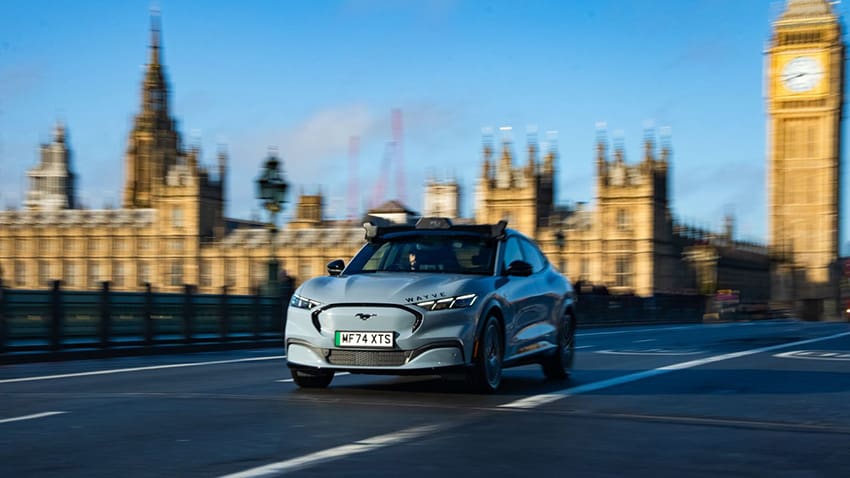
The black cab is the most reliable piece of street furniture in London. It has outlasted hansom carriages, two world wars and the rise of Uber. But the trade now faces an opponent it cannot intimidate with a beep of the horn, an artificial intelligence that drives two million miles a week and never has to learn a single street name.
In a quiet corner of Westminster, just behind Parliament Square, a Jaguar I-Pace is nosing its way around a roundabout choked with tourists. The wheel is turning, the indicators are flicking on and off, the speed is precisely judged. The man in the driver’s seat is not driving. Alex Kendall, chief executive of the British self-driving start-up Wayve, has his hands in his lap.
A few miles east, in a hushed examination room at Transport for London, Steven Fairbrass is sitting his twentieth attempt at the Knowledge of London. He has been studying for eight years. He stumbles on a street name in Portland Place and the examiner, kindly, tells him to come back another day.
These two scenes, highlight the future of London transport and frame the most consequential business story the capital’s streets have seen in a generation. The world’s most heavily regulated taxi trade is colliding with one of the world’s most heavily capitalised pieces of artificial intelligence, and the collision is going to shape everything from urban property values to the United Kingdom’s industrial strategy.
A trade already in retreat
The numbers tell their own grim story. Licensed black cab drivers in London peaked at 25,538 in 2014. By November 2024 the figure had fallen to 16,965, a contraction of more than a third in a decade. Over the same period the number of licensed private hire drivers, Uber, Bolt, Addison Lee and the rest, has grown by 82 per cent, to 107,884. As Business Matters has previously detailed, the lost fare income runs into hundreds of millions of pounds a year, and the trade’s underlying cost base, electric-vehicle financing, congestion charging, insurance, keeps rising.
The pipeline of new cabbies is drying up faster than the existing workforce is retiring. The pass rate for the Knowledge, the test that for 161 years has separated the “knowledge boys” from the rest, has slumped from 59 per cent in 2020 to 38 per cent in 2025. Steve McNamara, head of the Licensed Taxi Driver’s Association, has warned that without intervention the trade could be functionally extinct by 2045.
Into this softening market arrive two competitors with very different business models but identical ambitions.
Waymo, the autonomous-driving arm of Alphabet, has been quietly mapping a 100-square-mile patch of London since the autumn
Silicon Valley meets the South Circular
Waymo, the autonomous-driving arm of Alphabet, has been quietly mapping a 100-square-mile patch of London since the autumn. A fleet of around 100 Jaguar I-Paces, fitted with the company’s proprietary stack of 29 cameras, six radars and five lidar units, has been recording the city’s curious right-hand-drive choreography. The company, as Business Matters reported earlier this year, is targeting a fully driverless commercial launch in the fourth quarter of 2026, in partnership with the fleet operator Moove.
Waymo’s co-chief executive, Tekedra Mawakana, points to a fleet that has now driven more than 170 million paying-passenger miles in the United States and a safety record that, the company says, shows 92 per cent fewer serious-injury crashes than the human benchmark. “We travel over two million miles a week,” she recently told Anderson Cooper for a CBS Minutes piece. “Humans drive about 700,000 miles in a lifetime, so this is almost three lifetimes per week that our fleet is driving.”
Wayve, the Cambridge-founded scale-up backed by Microsoft, Nvidia and now Uber, takes a deliberately different approach. Its AI Driver is a foundation model trained end-to-end on millions of hours of footage, designed to generalise to any city rather than relying on the pre-built high-definition maps that Waymo favours. The bet is leaner, faster and, in theory, exportable. It has been enough to attract a $1bn funding round last year and a valuation of $8.6bn, the richest yet awarded to a British AI company. In May, Wayve signed a Memorandum of Understanding with the Department for Business and Trade to fast-track the path from test fleet to commercial deployment.
The prize is not just London fares. Ministers estimate that the autonomous vehicle sector could add £42bn to the UK economy and create close to 40,000 jobs by 2035. Whoever wins London, the most complex, most regulated and most observed urban driving environment in the western world, wins a benchmark that can be sold to every other capital.
The regulatory starting gun
For years, the British self-driving question was theoretical. The Automated Vehicles Act 2024 settled the legal architecture, creating a new category of “authorised self-driving entity” that takes on legal liability when the car is in charge. In a significant acceleration, the Department for Transport has brought forward the Automated Passenger Services permitting regime to spring 2026, allowing pilots of driverless taxi and bus services with no safety driver onboard. The Vehicle Certification Agency has been confirmed as the single national gatekeeper deciding which vehicles can carry paying passengers.
This matters commercially because permits, not technology, were the real bottleneck. Now the path is clear. Uber, which is partnering with Wayve, plans to fold autonomous vehicles into its existing London app. Bolt has indicated it will follow. Waymo’s pilot may carry no driver at all from day one. Within twelve months, a Londoner could be hailing a robotaxi on the same screen they currently use to summon a human one.
The human moat
The cabbies’ counter-argument is not that the technology will fail. It is that a London journey is not a navigation problem.
The Knowledge requires aspiring drivers to memorise some 25,000 streets and 20,000 points of interest within a six-mile radius of Charing Cross. Tom Scullion, who has been driving for 34 years, says he is regularly asked to ferry unaccompanied children to school and a regular client’s Irish wolfhound to the vet. The trust is a function of the licence, and the licence is a function of the years of study.
It is also a function of biology. Research by the late Professor Eleanor Maguire at University College London famously demonstrated that the posterior hippocampus, the brain’s spatial filing cabinet, grows measurably larger in qualified cabbies. New work from UCL’s Spatial Cognition Group suggests, intriguingly, that taxi drivers’ route-planning strategies could in turn inform the next generation of AI navigation systems, an irony not lost on the trade.
Whether that biological moat translates into commercial defensibility is the question that matters in the boardroom. Wayve and Waymo are not pitching themselves as better navigators. They are pitching themselves as cheaper, always available and, they argue, safer. In a city where average black cab fares have risen sharply with electric-vehicle financing costs, price competition is the threat the trade has the least answer to.
What it means for UK plc
The substantive question is not whether the cabbie survives, it is what the disruption tells us about Britain’s appetite for tolerating one. The Treasury has banked on AV adoption to lift productivity and rejuvenate UK automotive manufacturing. The National Wealth Fund is reportedly close to backing the Oxford-founded driverless start-up Oxa. Sherbet London has just raised £40m to electrify its black cab fleet, an explicit defensive play. Insurance underwriters, fleet operators, mapping companies and local councils are all being asked to model a scenario that did not exist eighteen months ago.
Three commercial implications stand out. The first is that London is being treated by the world’s largest AV companies as a global proving ground; success here unlocks a regulatory passport to Paris, Berlin and Tokyo. The second is that the United Kingdom, almost uniquely among large economies, has both a credible domestic champion in Wayve and a willing regulator, which is rare leverage in a sector dominated by American capital. The third is that the long-feared “Uberisation” of the taxi industry was, in retrospect, a soft landing. The next disruption removes the driver altogether, and with it the principal cost line, the principal customer-service complaint and, less comfortably, the principal employer of working-class Londoners who never went to university.
The black cab will not vanish overnight. The same regulatory frame that admits Waymo also affirms the taxi trade’s protected status to ply for hire on the street, and the iconography remains commercially valuable: every tourism board on earth would pay to keep a TX5 in the establishing shot. Sherbet’s investors, evidently, agree.
But the economics are unforgiving. The number of “appearances” booked at TfL each year is falling. The capital cost of a new electric London-style cab now exceeds £70,000. And the next generation of would-be cabbies, including 41-attempt Knowledge graduate Anshu Moorjani, are entering a market in which their newly enlarged hippocampi will be competing with neural networks that learn faster every week.
A century after the last horse-drawn hansom left the streets of London, the same city is preparing to host the first commercial robotaxi service in Europe. The Knowledge made the London cab the gold standard of urban transport. Whether it survives the algorithm is now, finally, a question with a deadline.
Read more:
The Knowledge versus the algorithm: inside London’s £42bn robotaxi reckoning