
Eyes Openers
  • World News
  • Business
  • Stocks
  • Politics
  • World News
  • Business
  • Stocks
  • Politics

Eyes Openers

Category:

Business

Key Evidence Truck Accident Attorneys Use to Build Their Cases
Business

Key Evidence Truck Accident Attorneys Use to Build Their Cases

by June 23, 2026

New York’s transportation network is one of the busiest in the country, with commercial trucks traveling its highways, city streets, industrial corridors, and delivery routes every day.

These vehicles play a vital role in keeping businesses supplied and communities connected, but their size and weight can also make collisions particularly devastating when accidents occur. For those injured in a truck crash, the aftermath often brings far more than physical recovery.

Questions about liability, insurance coverage, financial losses, and long-term medical needs can quickly become overwhelming, especially when large trucking companies and their insurers begin their own investigations. Unlike many other motor vehicle accidents, truck collision cases frequently involve extensive records, technical data, and multiple parties whose actions may have contributed to the incident. Building a strong claim requires uncovering and preserving critical information before it disappears. This is why firms such as Shulman & Hill NYC truck accident attorneys focus heavily on identifying and analyzing the evidence that can strengthen a victim’s path toward accountability and compensation.

Early Scene Proof

Fresh scene evidence can say what witnesses miss. Skid marks, gouged asphalt, debris spread, vehicle rest positions, and damaged barriers may reveal braking, speed, and impact angle. Nearby traffic cameras, storefront video, and dash footage can add timing. Street repairs, weather, and cleanup crews can quickly erase those details.

Legal Team Review

Commercial truck claims can involve federal safety rules, city routes, dispatch records, cargo duties, maintenance vendors, and multiple layers of insurance. Injured people often need early guidance before carriers shape the record. Accident attorneys can evaluate crash facts, preserve key documents, and identify responsible parties while deadlines and evidence remain manageable.

Police Reports

Police reports provide the first organized account. They usually list drivers, vehicles, location, injuries, citations, witness names, and roadway conditions. Diagrams or officer notes may help, but they are rarely complete. A report can overlook brake failure, false logs, unsafe hiring, poor loading, or hidden camera footage.

Driver Records

A driver file can reveal risk long before a collision. Attorneys may review license status, training materials, medical certification, drug testing records, prior violations, and employment history. These documents help determine whether the carrier used reasonable hiring and supervision practices. Repeated warnings can point beyond one driver’s mistake.

Electronic Data

Commercial vehicles often store technical information after a hard impact. Event data may show speed, braking, throttle position, steering movement, and seat belt use. Telematics systems can record harsh stops, route changes, or lane departures. Attorneys send preservation notices quickly because digital records may be overwritten, deleted, or altered.

Logs And Schedules

Fatigue evidence often appears in patterns rather than in a single document. Attorneys compare hours records with fuel receipts, toll data, delivery paperwork, phone records, dispatch messages, and location history. Inconsistencies may reveal rushed routes or inaccurate entries. A tired operator may react late, miss stopped traffic, or drift from a marked lane.

Maintenance Files

Heavy trucks require regular inspection, repair, and documentation. Brake service notes, tire invoices, inspection sheets, and repair orders can reveal whether safety work was skipped. Post-crash inspections may reveal worn parts, lighting defects, fluid leaks, or steering problems. Poor upkeep can link company practice to preventable roadway injury.

Cargo Evidence

Cargo affects braking, balance, and rollover risk. Attorneys may inspect bills of lading, weight tickets, loading diagrams, photos, and shipper instructions. Overweight, loose, or uneven freight can lengthen stopping distance or shift during a turn. That evidence may bring loaders, contractors, brokers, or shippers into the claim.

Witness Accounts

Witnesses help place technical evidence in a human sequence. They may describe speed, lane changes, horn use, phone distraction, signals, or driver behavior before impact. Prompt interviews matter because recall becomes less exact over time. Independent accounts can support video, challenge a company’s narrative, or fill gaps in police notes.

Medical Proof

Medical records link the crash to bodily harm. Emergency notes, imaging, surgical reports, therapy charts, specialist opinions, and medication histories show injury patterns and severity. Attorneys also review work limits, future care needs, pain symptoms, and functional loss. Clear documentation helps answer claims that trauma was minor, delayed, or unrelated.

Expert Analysis

Experts translate technical material into clear findings. Reconstruction professionals study crush damage, sight lines, stopping distance, road grade, and impact angles. Physicians address causation, prognosis, and future treatment needs. Economists calculate lost income and reduced earning capacity. Their opinions help juries connect documents with real physical and financial consequences.

Insurance And Damages

Truck claims may involve more than one policy. Coverage can come from a carrier, trailer owner, broker, shipper, maintenance provider, or manufacturer. Attorneys review contracts, endorsements, and coverage limits to identify available sources. Damages may include medical bills, lost wages, reduced earning power, pain, disability, property loss, and family strain.

Conclusion

A strong truck crash case is built through early preservation, careful review, and disciplined proof. Scene evidence, company files, electronic data, witness accounts, medical records, and expert analysis each answer different questions about fault and harm. When those pieces fit, the claim becomes harder to dismiss. Clear evidence gives injured people a firmer path to compensation and helps place responsibility where the facts support it.


Read full article →

June 23, 2026
Amid rising obesity, Europe must not import MAHA’s sweeping campaign against UPFs
Business

Amid rising obesity, Europe must not import MAHA’s sweeping campaign against UPFs

by June 23, 2026

As governments in high-obesity countries ramp up efforts to improve nutritional health, ultra-processed foods (UPFs) are increasingly in the firing line, giving policymakers a highly visible target through which to project resolve.

Leading the global anti-UPF movement, US Health Secretary and ‘MAHA’ architect, Robert F. Kennedy Jr., revealed earlier this month that his administration had drafted a UPF definition, with the ever-elusive criteria, now pending White House approval, expected in the coming months.

While projecting a sense of action, such attempts to define and regulate UPFs face a basic obstacle; namely, that there is still no broadly-agreed scientific definition, with researchers’ classification of foods as UPFs under the NOVA system varying widely. Even FDA nutrition official Claudine Kavanaugh recently conceded that scientists are still trying to determine whether health outcomes stem from a food’s processing levels or nutrient composition, stating that “there’s a lot of gray areas, given the conflicting information that’s out there.”

Given this major informational gap, public policy must resist the blunt, hasty interventions advanced under the MAHA model. As Washington pushes this agenda onto the global stage, and signs emerge that Europe may look to RFK Jr.’s approach for inspiration, Brussels should avoid the trap by pursuing precise, evidence-based regulation while building a multi-faceted prevention strategy for obesity, heart disease and related non-communicable diseases (NCDs).

EU’s urgent search for answers

Europe’s nutritional health challenge has become impossible to ignore. Today, nearly 60% of adults and almost one in three children in the WHO European Region live with overweight or obesity, while cardiovascular disease claims 1.7 million EU lives each year. NCDs sit at the point where individual health, quality of life and strained public finances collide, confronting Europe with a challenge its health systems cannot meet through treatment alone. Prevention must therefore become the organising principle, reshaping the conditions in which people eat, move, work and age, rather than reducing the target to a single convenient villain.

Unveiled in December 2025, the EU’s ‘Safe Hearts Plan’ rightly recognises the scale of the cardiovascular burden and pays lip service to effective prevention. Yet its food agenda risks echoing the RFK approach by putting UPFs in the policy crosshairs before establishing whether such a broad and contested category can support coherent, science-based regulation. Concerningly, Commissioner Várhelyi has praised the RFK Jr.’s anti-UPF, “#eatrealfood,’ campaign, while signaling a will to cooperate with the US on this issue “to turn shared ambition into concrete results.”

However, embarking upon this path of imitation is unlikely to deliver the anticipated benefits, as it lacks not only firm scientific grounding but also broad political buy-in. The Plan’s initial UPF approach quickly proved divisive, with an earlier draft, steered by EU Health Commissioner, Olivér Várhelyi, reportedly exploring EU-wide levies on ultra-processed foods, prompting broad criticism from various DGs primarily centred around the absence of sufficient evidence to back such a policy. This opposition did not fall on deaf ears, with the current version of the bloc’s heart health plan dropping the concrete commitment to a UPF tax and instead vaguely referring to “possible financial actions.”

UPF debate exposes Brussels’ wider policy choice

The Brussels debate over UPFs in the Safe Hearts Plan captures a wider choice now facing the Commission: whether to pursue visible but narrow interventions, or to build a genuinely preventive health agenda rooted in evidence, proportionality and practical support for healthier lives. While certain public health actors have welcomed the plan’s preventive ambition, they have also warned that it still lacks the stronger measures needed to turn that vision into reality, making it all the more vital that Europe’s response delivers prevention in practice rather than in theory.

The first flaw in the current backlash against UPF is that the category is too crude for the certainty now attached to it. A recent Healthy Eating Research report, highlighted by the Physicians Committee for Responsible Medicine, points to the same weakness, showing foods grouped as UPFs vary sharply in composition, use and nutritional profile. As Noah Praamsma rightly asserts, “we need to be more nuanced.” In short, when the science remains unsettled, policymakers cannot simply treat UPFs as a self-evident marker of risk.

Secondly, the processing label may be obscuring the real biological mechanisms at work. The authors of a recent Perspectives report argue that many effects attributed to UPFs can be explained by better-established factors such as calorie density, fibre and protein content, texture and eating rate, rather than processing itself. That matters because these are also the variables increasingly identified in research on the microbiome, satiety, metabolic health and how different foods interact with human biology. In other words, the real question is not simply how processed a food is, but what that food actually does in the body.

Moreover, even the classification system underpinning the UPF debate is far less robust than the politics and media headlines would lead one to believe. Crucially, the NOVA system attempts to describe a product’s degree of processing, not its healthiness or potential contribution to diet-related disease, yet even in this regard its limits have become apparent. Indeed, one European Journal of Clinical Nutrition study found low agreement among French food and nutrition specialists assigning foods to NOVA groups. If even experts struggle to apply UPF designations consistently, policymakers should be wary of building labels, taxes or restrictions around it.

High stakes for Europe’s anti-obesity agenda

For Europe, the danger is not only regulatory overreach, but consumer confusion. A recent Food Standards Agency survey found that, among people who had changed their diets for health reasons, eating less processed food had become a higher priority than cutting high-sugar products or eating more fruit and vegetables – findings which should worry public health officials. When processing becomes the dominant health signal, people may make well-intentioned but poorly informed choices, treating a vague industrial marker as more important than a food’s nutritional profile or overall diet quality.

Moving forward, Europe cannot afford to confuse anxiety with effective prevention, nor does it need to choose between complacency and overreach. With obesity still high and governments setting ambitious reduction targets, the evidence gap around UPFs should push EU and national leaders toward smarter regulatory action, not superficial definitions and labels.

If the Commission is serious about reversing the rise of obesity, heart disease and other NCDs, they must  instead invest in meaningful prevention measures capable of changing daily lives, from balanced diets, healthier school meals and more active cities to earlier screening, mental health support, less sedentary time and practical help to sustain healthier routines.

Read full article →

June 23, 2026
Burnham and the wealth question now hanging over British business
Business

Burnham and the wealth question now hanging over British business

by June 23, 2026

Andy Burnham, the front-runner to succeed Sir Keir Starmer as prime minister, has spent years making a single argument with unusual consistency: that Britain taxes work too heavily and wealth too lightly.

After his Makerfield by-election victory and Starmer’s resignation, that argument has stopped being a talking point on the fringes of his party and become a question the City, the boardroom and the family business are all now being forced to answer.

The shift carries “considerable consequences for households, businesses, investors and the economy,” warns Nigel Green, chief executive of deVere Group, one of the world’s largest independent financial advisory organisations. His intervention lands as investors increasingly weigh what a Burnham government could mean for taxation, investment, property, wealth creation and Britain’s competitiveness, at a moment when global capital has more choice than at any point in living memory.

Burnham has long held that the country leans too hard on taxing earnings, while accumulated wealth, assets and property should shoulder a greater share. As he moves closer to Downing Street, those instincts are migrating from the political margins to the centre of the economic debate. The unease is already measurable: Business Matters has reported that eight in ten SME owners fear what an Andy Burnham premiership would mean for their business.

“Andy Burnham’s seemingly unstoppable ascent to the top of British politics marks one of the most significant moments for investors in years,” Green says. “For the first time in a generation, Britain could soon have a prime minister whose political instinct is to look at wealth and ask whether it should be paying more. This matters because the answer doesn’t just affect the wealthy. It affects investment, jobs, business formation and economic growth.”

Burnham has not proposed a wealth tax, an exit tax or any specific package aimed at private wealth. Yet investors are already training their attention on the areas most exposed if a future government tried to tilt the burden away from earnings and towards assets.

“Capital gains tax, inheritance tax, property taxation, investment income and larger estates are all featuring more prominently in discussions taking place across financial markets,” Green notes. “The prospect of a government placing greater emphasis on the taxation of wealth is already triggering discussions among investors, entrepreneurs and business owners about the future direction of policy.”

The questions extend to council tax, stamp duty and land taxation. Burnham has previously backed property tax reform and has been linked to calls to replace the current council tax system with approaches tied more closely to underlying land values. Whether those ideas survive contact with the Treasury is another matter, and as Business Matters has explored, the case for whether Burnham can win over Britain’s entrepreneurs is far from settled.

He inherits a difficult backdrop: weak growth, stretched public finances and mounting spending pressure. Public sector debt sits close to the size of the entire economy, while the bills for healthcare, pensions, infrastructure and defence keep climbing. Against that, any government faces hard choices about where to find revenue without choking off growth, a tension already visible in reports that the Treasury is weighing inheritance and capital gains tax reforms to plug a budget gap.

“Governments are right to pursue fairness,” Green says. “But fairness and competitiveness must coexist. The danger is that Britain drifts into a mindset where wealth creation becomes viewed with suspicion rather than encouragement.”

Britain remains one of the world’s leading destinations for investment, underpinned by deep capital markets, strong institutions, legal certainty and London’s standing as a global financial centre. But the competition has sharpened. Financial centres across Europe, the Middle East and Asia are actively courting entrepreneurs, investors and internationally mobile families.

“Investors around the world are watching Britain and asking a simple question: is this a country becoming more attractive to capital or less,” Green says. “The answer will determine where money flows next.”

The implications reach well beyond headline rates. Family business succession, property ownership structures, pension arrangements, investment portfolios and estate planning could all face greater scrutiny if future governments decide wealth should contribute a larger share of receipts.

“Britain already taxes capital gains. It already taxes inheritance. It already taxes property. It already taxes investment income,” Green observes. “The question is now whether a Burnham government would push further. And that’s precisely why investors are paying such close attention.”

The numbers explain the stakes. According to the Office for National Statistics, privately owned wealth in Great Britain stands at roughly £13.6 trillion, more than six times annual national income, with property, pensions and financial assets making up the overwhelming majority. That wealth is also highly concentrated: House of Commons Library analysis shows the wealthiest tenth of households hold around 41 per cent of the total, a concentration that fuels the argument that assets should do more of the fiscal heavy lifting.

For households, the consequences would stretch far past the ultra-wealthy. Changes to inheritance tax reshape family succession. Reforms to property taxation touch homeowners and landlords. Adjustments to capital gains alter the economics of investing and entrepreneurship. Pension tax relief and investment income could also be drawn in if policymakers hunt for revenue while shielding taxes on work.

“There’s a growing belief inside parts of politics that wealth represents an easy answer to difficult fiscal questions,” Green says. “History teaches us it’s rarely that simple. The more aggressively governments pursue existing wealth, the greater the risk they discourage future wealth creation.”

His core worry is the direction of travel. “Businesses invest for years ahead. Investors allocate capital for decades ahead. If they conclude Britain is becoming less welcoming to enterprise, they’ll adjust accordingly. A generation ago, wealth was relatively captive. Today it is very much mobile. It compares jurisdictions, tax systems and governments. And it moves.”

As momentum builds behind Burnham, Green frames the moment as a defining economic test. “Andy Burnham believes wealth should carry more of the burden. It’s a belief that has taken him a long way in politics. Now investors are asking what happens if it starts shaping government.”

“There’s a world of difference between saying wealth should pay more and designing policies that achieve it without damaging investment, entrepreneurship and growth,” he concludes. “That is the challenge waiting on the desk of any future prime minister Burnham. He is forcing a national conversation about who should pay more, work or wealth. Investors are asking whether Britain will end up paying the price.”

Read full article →

June 23, 2026
Oracle sheds 21,000 jobs in a year as AI rewrites the payroll
Business

Oracle sheds 21,000 jobs in a year as AI rewrites the payroll

by June 23, 2026

Oracle has cut around 21,000 roles worldwide over the past year, a stark sign of how quickly artificial intelligence is reshaping the cost base of the world’s largest technology firms, the US software and cloud computing giant’s latest annual report shows.

The company employed roughly 141,000 full-time staff as of 31 May 2026, down from about 162,000 a year earlier, according to Reuters. The reduction amounts to roughly 13 per cent of its global workforce.

In unusually candid language, Oracle told investors that the “deployment of AI technologies across our operations have resulted, and may continue to result, in reductions to our workforce”. The admission, buried in the firm’s annual filing, makes Oracle one of the few blue-chip employers to explicitly link headcount cuts to automation rather than the usual corporate shorthand of “efficiency” or “streamlining”.

The cuts have not come cheap. Oracle said it booked about $1.8bn (£1.36bn) in severance and other restructuring costs over the year, nearly five times the $374m it spent the year before. The figures are set out in the company’s annual report filed with the US Securities and Exchange Commission.

The bulk of the reductions appear to have landed in April, when senior employees began posting online about “significant” job losses, though the full scale only became clear once the annual report was published.

Oracle was careful to flag the risks. It acknowledged that the reorganisation “can be disruptive” and warned that thinning out certain teams could leave it short of skilled workers in particular roles, denting productivity and, ultimately, earnings.

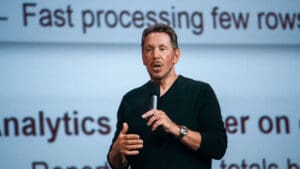
The pattern at Oracle, cutting people while pouring money into machines, is becoming the defining trade-off of the AI era. The company has been racing to build data centres for the likes of OpenAI and Meta, and plans to spend at least $50bn on infrastructure this year alone. Co-founder Larry Ellison, one of the world’s richest people and the group’s chief technology officer, has staked Oracle’s future on becoming the plumbing behind the AI boom.

For a sector where staff are typically the single biggest expense, the maths is increasingly hard to ignore. Across the industry, more than 100,000 technology workers have lost their jobs in the past year, according to employment trackers, even as the giants commit eye-watering sums to the technology. Google, Amazon and Meta alone plan to invest some $650bn between them this year.

Oracle is far from alone. Facebook-owner Meta has been cutting roles while ramping up its AI budget, as Business Matters reported when Meta moved to axe 8,000 jobs to fund its $145bn AI push. Amazon, meanwhile, has signalled the deepest cuts of all, with plans to shed around 30,000 corporate roles in several rounds, detailed when the retailer axed 16,000 jobs to “remove bureaucracy”. Amazon, which employs more than 1.5 million people globally, intends to spend $200bn on AI over the next year, the largest commitment of any big technology company.

A senior Amazon executive captured the prevailing mood in an internal note last October, arguing that the company needed to be organised “more leanly” because AI was “enabling companies to innovate much faster than ever before”.

For all the talk of innovation, the human cost is mounting, and it is being felt well beyond Silicon Valley boardrooms. The squeeze is now reaching the bottom of the career ladder too, with entry-level vacancies in the UK down by almost a third since ChatGPT launched. Oracle’s frank acknowledgement that AI is directly displacing workers may prove a watershed: where one of the world’s most powerful software firms leads in its disclosures, others may feel obliged to follow.

The question for businesses watching from the sidelines is no longer whether AI will reshape their workforces, but how openly they are prepared to say so.

Read full article →

June 23, 2026
Getty opens its archive to ChatGPT as OpenAI deal sends shares soaring
Business

Getty opens its archive to ChatGPT as OpenAI deal sends shares soaring

by June 23, 2026

One of the world’s largest photography agencies has struck a multi-year licensing agreement with OpenAI, a remarkable turn for a company that only months ago lost a high-profile copyright battle against another artificial intelligence developer.

Getty Images said the deal will see images from its library surface within ChatGPT’s search display, folding richer visual features into the chatbot. Crucially, the agreement stops well short of handing OpenAI the keys to Getty’s archive: it does not allow the images to be used to train OpenAI’s own image generator, Dall-E. Neither company disclosed the financial terms.

Investors liked what they saw. Shares in Getty Images jumped as much as 65 cents, or roughly 108 per cent, to $1.26 in early afternoon trading in New York, a rare burst of optimism for a stock that has been badly bruised this year.

Craig Peters, chief executive of Getty Images, framed the deal as a vote of confidence in licensed content over the free-for-all that has defined much of the AI land grab. “High-quality, licensed visual content makes AI-powered search and discovery more useful and more trustworthy,” he said. “This partnership with OpenAI reflects a shared recognition of that, and together we will deliver richer visual experiences to ChatGPT users.” The full terms were set out in Getty’s own announcement of the partnership.

Getty’s total catalogue stands at about 609 million images, placing it among the largest photography platforms on the planet. Yet scale has offered little protection from the market’s anxieties. The shares have shed more than 50 per cent of their value this year, dragged down by fears that AI-powered image generators could hollow out demand for traditional photo libraries altogether.

That existential worry helps explain Getty’s other big move: the company is finalising a $3.7 billion merger with its long-time rival Shutterstock. The two argue that combining forces will create a business with an unrivalled photo library and, just as importantly, the scale to invest in its own image-generation models rather than simply ceding the territory to Silicon Valley.

The OpenAI agreement marks a striking strategic pivot. In 2023, Getty sued Stability AI, the UK-based developer behind the Stable Diffusion model, alleging it had scraped more than 12 million images from Getty’s library without permission.

The case proved a cautionary tale about the limits of existing copyright law. Unable to prove that the training had taken place in the UK, Getty was forced back onto a secondary infringement claim, arguing that Stability had effectively imported an infringing product in breach of British copyright rules. A High Court judge found against the agency, ruling that Stability’s model did not actually store or copy images from Getty’s library. As Business Matters reported when the judgment landed, the decision was widely read as a setback for rights holders, even as parallel proceedings rumble on in the United States. Stability itself had earlier cast the lawsuit as an “existential threat” to the generative technology industry.

Having tested the courtroom route and found it wanting, Getty appears to have concluded that licensing is the surer path to getting paid.

It is not alone. Across publishing, music and now stock photography, the licensing deal has emerged as the industry’s preferred answer to the AI question. Getty signed a comparable agreement with Perplexity AI last November, while OpenAI has lined up deals with major publishers including News Corp, owner of The Times, as well as The Guardian and the Financial Times. The chatbot’s growing commercial ambitions are increasingly visible elsewhere too, from advertising trials within ChatGPT to its preparations for a stock market debut.

For Getty, the calculation is straightforward enough. If AI tools are going to reshape how people find and use images, the agency would rather be paid to be part of that future than litigate its way through it. As Bloomberg noted, the market reaction suggests investors, for now at least, agree.

Read full article →

June 23, 2026
StubHub stung for nearly £900k as the CMA cracks down on hidden ticket fees
Business

StubHub stung for nearly £900k as the CMA cracks down on hidden ticket fees

by June 23, 2026

Ticket resale platform StubHub has been fined just under £900,000 and ordered to repay more than 50,000 customers after the Competition and Markets Authority (CMA) found it failed to show fans the full price of their tickets before they reached the checkout.

The watchdog ruled that StubHub UK breached consumer law by hiding mandatory charges, the practice known as “drip pricing”, in which a tempting headline figure creeps upwards once unavoidable extras such as delivery and service fees are bolted on. Between 6 April and 7 December 2025, fans buying through the site were drawn in by one price only to be presented with a higher one once compulsory costs appeared later in the journey.

More than 50,000 customers are now in line for refunds totalling over £590,000, with the average payout expected to be around £10 per transaction. The CMA said StubHub would contact affected fans directly, so there is no need for buyers to come forward themselves.

“Hitting customers with hidden fees is illegal,” said Emma Cochrane, executive director of consumer protection at the CMA. “It’s not fair to draw people in with what looks like a good deal, only for them to find the real price is higher when they get to the checkout due to extra charges that can’t be avoided.”

The company admitted breaking the law and agreed to settle the case early, earning a 40 per cent reduction on its financial penalty in the process. It is worth noting that stubhub.co.uk is operated by Ticketbis S.L. and, the CMA stresses, is not connected to or affiliated with the US-listed StubHub Holdings Inc.

The StubHub ruling is the latest sign that the CMA intends to use the muscle handed to it under the Digital Markets, Competition and Consumers Act 2024. Since April 2025, the regulator has been able to investigate suspected breaches of consumer law and impose penalties directly, without first having to take a business to court, a shift that has visibly quickened the pace of enforcement.

The action against StubHub follows hot on the heels of a far larger penalty for the motoring giant the AA, which was fined £4.2m and told to refund more than 80,000 learner drivers over a hidden booking fee. Hidden charges of this kind are reckoned to strip around £2.2bn a year out of consumers’ pockets, and the CMA has made clear it is only getting started, having already opened investigations into a further eight firms over their online pricing practices.

The rules themselves are simple enough. Any charge a customer cannot realistically avoid, whether a booking fee, a service charge or a delivery cost, must now be baked into the price shown up front rather than sprung at the till. For the events and entertainment sector, where mandatory fees have long been part of the furniture, the message from the regulator could hardly be blunter, as set out in its wider consumer protection drive on online pricing.

StubHub’s troubles are not confined to these shores. In the United States, the firm agreed to refund some $10m to consumers after the Federal Trade Commission accused it of advertising live-event tickets without fully disclosing compulsory fees, a settlement the FTC announced earlier this year. For a business that floated on the New York Stock Exchange in 2025, the twin actions on either side of the Atlantic land at an awkward moment and underline how quickly transparent pricing has climbed the regulatory agenda.

For SME founders and finance teams, the broader lesson is straightforward, if uncomfortable. The era in which a low advertised price could be quietly topped up at checkout is drawing to a close, and the cost of clinging to it, in fines, refunds and reputational damage, now plainly outweighs any short-term uplift in conversions. Honest pricing, it turns out, is not merely good manners. It is fast becoming the law.

Read full article →

June 23, 2026
Silicon Valley money lands on British AI certifier as John Doerr backs isometric
Business

Silicon Valley money lands on British AI certifier as John Doerr backs isometric

by June 23, 2026

The Silicon Valley investor John Doerr, an early backer of Google and Amazon, has written the second-largest cheque in a $40 million funding round for Isometric, the London-based industrial certification firm.

Doerr, the billionaire chairman of Kleiner Perkins, the California venture capital firm, invested in a personal capacity alongside the lead investor AVP, which counts the insurer Axa as its anchor backer. The round also drew fresh money from the venture firms Plural and Lowercarbon Capital, and builds on a $25 million raise struck in late 2022.

Eamon Jubbawy, founder and chief executive of Isometric (pictured), said attracting investors of Doerr’s stature would help the company “open doors”.

“We are not selling a simple product into small and medium-sized companies,” he said. “We are selling a suite of certification services into the largest companies in the world. The contract sizes can get very large over time, and having someone like John on board can help to unlock those doors to make those deals happen.”

Jubbawy set up Isometric in 2022 with an initial aim of bringing a more trusted certification process to schemes that remove carbon from the environment. Since then, more than a hundred companies have used its services when buying carbon credits as part of managing their emissions obligations.

Having built that registry of projects, each of which can be scrutinised by independent third parties, Isometric has since pushed into the broader industrial certification market. Deploying several different large language models to build its artificial intelligence tools, it now works with customers such as the miner Anglo American and the tech giants Microsoft and Google to check and certify that suppliers are meeting the environmental standards they have promised.

“Someone like Microsoft or Google wants to certify the carbon projects they are buying from, the clean energy and sustainable fuels they are procuring,” Jubbawy said. “If they are building out data centres, they want to certify the green steel and green cement, and certify the water usage, as they need to be within environmental safety guidelines. There are so many different certification products that they need.”

That breadth matters at a moment when corporate Britain is under growing pressure to prove its green credentials rather than simply assert them, a theme running through the government’s seventh carbon budget and its push to shield smaller firms from the next fossil-fuel shock.

Jubbawy said that by using AI to analyse data sets, Isometric was able to speed up and sharpen the accuracy of certification, cutting the time required from “months” to “hours”. The firm has been contracted to certify more than 16 million tonnes of carbon to date.

It is the kind of productivity dividend that analysts increasingly expect from well-targeted AI adoption, with one study estimating a £105bn revenue uplift for Britain’s mid-sized firms if the technology is taken up at pace.

The company has grown to employ 80 people across London and New York, including 15 with PhDs.

Jubbawy is no first-time operator. He is one of three co-founders of Onfido, the ID verification software provider acquired by the US security group Entrust in 2024 for $650 million. The co-founders, who met at Oxford University, together held about 16 per cent of the business.

For Doerr, whose early bets on Google and Amazon helped define a generation of Silicon Valley investing, the wager on Isometric is a smaller, more personal one. But for a London firm trying to sell trust to the world’s largest companies, a name like his on the share register may prove worth rather more than the cheque itself.

Read full article →

June 23, 2026
GMB warns MPs cost of not saving British Steel would have been ‘unfathomable’
Business

GMB warns MPs cost of not saving British Steel would have been ‘unfathomable’

by June 23, 2026

The cost of allowing steelmaking in Scunthorpe to collapse would have been “unfathomable”, the GMB union has told MPs, as the Public Accounts Committee weighs whether the government’s intervention to keep British Steel running represents value for money for the taxpayer.

Giving evidence to the committee, GMB national secretary Charlotte Brumpton-Childs set out the union’s case that ministers had little realistic choice but to step in when British Steel’s Chinese owner, Jingye, moved to shut the Scunthorpe blast furnaces. The committee is examining how well prepared the government was for that intervention and what taking the company into public ownership might ultimately cost.

“The cost of not saving steel in Scunthorpe would have been unfathomable, not only to the public purse, with redundancy and insolvency costs, but to the families and communities that rely on those jobs to exist,” Brumpton-Childs said.

She added: “Without the government’s intervention, tens of thousands of workers would be out of a job and the UK’s national security would have been at risk.”

Her remarks go to the heart of the committee’s inquiry. While much of the political debate has focused on the headline figure of public money committed to keeping the furnaces lit, the GMB’s argument is that the counterfactual, the bill for redundancy, insolvency and the loss of the UK’s last primary steelmaking capacity, would have dwarfed it. That is the calculation MPs must now interrogate.

The numbers underline why the question matters. The National Audit Office reported earlier this year that hundreds of millions of pounds had already been spent funding operations, wages and raw materials at the site, with the running total climbing as ministers kept production going. For a workforce of around 2,700 in Scunthorpe, and a wider supply chain stretching across the country, the stakes extend well beyond a single plant.

Ministers recalled Parliament to pass emergency legislation granting temporary control of British Steel after talks with Jingye broke down, scrapping the redundancy plans that had threatened to cut up to 2,700 jobs as the blast furnaces faced closure. The Steel Industry (Nationalisation) Bill would take the company into full public ownership, subject to a public interest test, building on the public ownership plan for Scunthorpe that the prime minister confirmed earlier in the saga.

For the GMB, the national security dimension is central. British Steel operates the country’s only remaining blast furnaces capable of producing virgin steel, the grade used in construction, rail and defence. Lose that capability, the union argues, and the UK becomes dependent on imports for materials it may one day need in a crisis, a vulnerability the Public Accounts Committee’s evidence session was convened to probe alongside the financial questions.

The committee’s findings, expected in the coming weeks, will shape how the eventual cost of nationalisation is judged, both against the money already spent and against the special measures and statutory powers ministers have leaned on to keep the Scunthorpe furnaces alight. For the SME suppliers, hauliers and engineering firms tied to the plant, the difference between intervention and collapse was never abstract. As the GMB’s evidence made plain, the bill for doing nothing would have landed somewhere too, just on workers and communities rather than on the Treasury’s ledger.

Read full article →

June 23, 2026
Small firms can buy ITV, Sky and Channel 4 airtime in minutes as Universal Ads launches in the UK
Business

Small firms can buy ITV, Sky and Channel 4 airtime in minutes as Universal Ads launches in the UK

by June 23, 2026

For decades, television advertising has been the preserve of brands with deep pockets and a media agency on retainer.

From today that changes. Comcast’s Universal Ads, the self-service platform built for the premium TV industry, has launched in the UK in partnership with Channel 4, ITV and Sky, opening the medium to the small and medium-sized businesses that have long watched from the sidelines.

For the first time, an SME can plan, buy and measure a single campaign across the three broadcasters’ sales houses, ITV Media, Sky Media and Channel 4 Sales, from one interface. The pitch is deliberately blunt: buying broadcaster-quality TV should feel as simple as buying social. Select a budget, choose your audience, upload the creative and go live, in minutes rather than weeks.

That simplicity is the whole point. The barrier to TV has never really been doubt about whether it works, it has been the cost, the complexity and the sense that you needed an agency to get near it. Strip those away and you hand growth-focused firms, digital-native, direct-to-consumer and the rest, a route to millions of viewers without surrendering the brand safety and measurable impact that only broadcaster TV delivers.

“This milestone represents the next phase of Universal Ads as we expand onto the global stage,” said David Shaw, Head of Global Expansion at Universal Ads. “Together with Channel 4, ITV and Sky, we’ve built a platform that changes how TV advertising works in the UK today, bringing an experience that feels as simple as social, while preserving everything that makes broadcaster TV trusted, effective and impactful.”

The launch, first unveiled at Cannes Lions in 2025, follows a year of work between Comcast and the three broadcasters’ product, operations and commercial teams to turn a statement of intent into a market-ready product. It is a notable show of collective will from rivals who, in a fragmenting media market, increasingly see the changing media landscape as a shared challenge rather than a zero-sum fight for spend.

Rak Patel, Chief Commercial Officer at Channel 4, framed it as a competitive necessity. “Lowering the barriers to premium media can be a gamechanger for smaller brands,” he said. “Greater collaboration across broadcasters can simplify TV buys for advertisers, attract new categories and brands into TV, and help ensure premium TV remains innovative and competitive alongside global social and digital platforms.”

Kelly Williams, Managing Director, Commercial at ITV, said the initiative “proves that trusted, premium TV environments deliver real value for small-to-medium advertisers. Driving this kind of innovation is a major step forward. It allows broadcasters to make TV advertising more accessible, effective and future-proofed for the entire industry.”

Karen Eccles, Managing Director, Sky Media, added: “Through Universal Ads, we are breaking down traditional barriers and making it easier than ever for a whole new wave of brands to harness the power of TV. This partnership is an opportunity to show that the quality and impact of broadcast TV is now truly accessible to everyone.”

The timing is telling. Many smaller firms have spent the past decade turning away from traditional marketing in favour of channels they can run themselves, attracted by low entry costs and instant measurement. Universal Ads is, in effect, the broadcasters’ answer: keep the self-serve convenience SMEs have come to expect from social, but attach it to the reach and trust of the living-room screen. The evidence that TV pays its way for smaller advertisers is well documented, with industry body Thinkbox’s research on supercharging small businesses pointing to strong returns for first-time TV brands.

Available to US advertisers for more than a year, where it has reported encouraging early results, the platform is built on an API-first foundation, giving brands and technology partners room to integrate, customise and scale. It is aimed squarely at firms that have found TV out of reach, yet it retains the targeting depth and performance reporting that larger advertisers and agencies expect. The broader announcement, set out by Channel 4, ITV and Sky, positions the marketplace as a way to widen the pool of brands on screen while protecting the standards that define premium TV.

For the UK’s army of smaller advertisers, the proposition is straightforward: more brands on screen, more choice for viewers and, for the first time, a national TV campaign that can be live before lunch. It is a development that sits comfortably alongside other moves to put broadcast within reach of growing firms, including ITV’s £500,000 TV advertising prize for SMEs. Whether it shifts budgets at scale will become clear over the coming year, but the direction of travel is unmistakable. Premium TV is no longer just for the big players.

Read full article →

June 23, 2026
Can Andy Burnham win over Britain’s entrepreneurs?
Business

Can Andy Burnham win over Britain’s entrepreneurs?

by June 23, 2026

So that’s that, then. Keir Starmer has read the room, found it on fire, and quietly let himself out of the back door.

Andy Burnham, the man who has spent years doing his best impression of a Prime Minister-in-waiting from a tram stop in Greater Manchester, is now the overwhelming favourite to be holding the keys to No.10. And the question I keep being asked, by founders who have built something real with their own sweat and overdraft, is a simple one: is he on our side or isn’t he?

I should declare an interest. I advised David Cameron’s government on enterprise, and I sat alongside the late, magnificent Lord Young of Graffham, the sharpest business brain to wander the corridors of Whitehall in a generation. Young understood something that most politicians never grasp, which is that you cannot conjure growth from a spreadsheet or a press release. You get it by listening to people who have actually met a payroll on a Friday when the bank has gone quiet. His reports on small business were not poetry, but they were honest, and they moved the needle. We need that voice in the room again.

Now, Burnham is not a fool, and he is not anti-business in the snarling, placard-waving sense. He talks a good game about “business-friendly socialism,” whatever that turns out to mean when the civil servants get hold of it. He wants to cut business rates for the corner café and the struggling pub, which is grand, and I will buy the first round. But the mood music among the people who actually create jobs is not exactly a standing ovation. A recent survey found that eight in ten SME owners are nervous about what a Burnham premiership means for their business, and you do not get a number like that by accident.

Here is the bit Burnham needs to understand, and understand fast. The genius of a healthy economy is not the wealth that gets created. It is what happens to that wealth afterwards. The founder who sells her software company for forty million does not stuff it under the mattress. She becomes an angel investor. She backs three more founders, mentors a dozen, and sets up a fund. That is the flywheel, and it is the single most powerful engine of prosperity we have. The Tony Blair Institute, no nest of swivel-eyed capitalists, has written about exactly this, the way start-up success recycles into the next generation of scale-ups. Nine out of ten angels reinvest their exit money. That is not greed. That is the machine working.

And here is my worry. You cannot, on the one hand, ask entrepreneurs to take insane risks, remortgage the house, miss the kids’ bedtimes for a decade, and then, on the other, signal that the moment they succeed you intend to relieve them of the reward through a wealth tax, a land tax, or whatever the focus group has christened it this week. Burnham has been artfully vague on this, which is its own kind of answer. Vagueness is what frightens founders. They can plan for bad news. They cannot plan for a shrug.

The thing is, the money is sitting there, ready to be put to work. The challenge for whoever is next PM is not creating start-up wealth. We are rather good at that, thank you. The challenge is getting it recycled into the real economy instead of fleeing to Lisbon and Dubai, where the welcome is warmer and the tax letters are kinder. That is a solvable problem, but only if Burnham does the one thing this government has been allergic to, which is actually listening to entrepreneurs about how to unlock the funding rather than lecturing them about fairness.

So can he win us over? Yes, he can, and I would rather like him to. But it requires a leap that does not come naturally to a man whose instincts were forged in the Labour movement. He needs a Lord Young of his own, a proper entrepreneur with calloused hands and scar tissue, sitting at the heart of Downing Street, not a special adviser who once read a book about disruption on the train to Manchester. He needs to treat founders not as a cash machine to be tapped but as the goose that lays the golden egg, and you do not, if you have any sense, threaten the goose.

Burnham has charisma, a northern soul, and a genuine knack for sounding like he means it. What he lacks, so far, is a credible promise to the wealth creators that their success will be celebrated rather than confiscated. Make that promise, and keep it, and he could be the most pleasant surprise this country has had in years. Break it, and the flywheel stops, the money leaves, and we are all the poorer for it. Over to you, Andy. The kettle is on.

Read full article →

June 23, 2026
  • 1
  • …
  • 6
  • 7
  • 8
  • 9
  • 10
  • …
  • 12

    Get free access to all of the retirement secrets and income strategies from our experts! or Join The Exclusive Subscription Today And Get the Premium Articles Acess for Free

    By opting in you agree to receive emails from us and our affiliates. Your information is secure and your privacy is protected.

    Popular Posts

    • A GOP operative accused a monastery of voter fraud. Nuns fought back.

      October 24, 2024
    • Trump’s exaggerated claim that Pennsylvania has 500,000 fracking jobs

      October 24, 2024
    • American creating deepfakes targeting Harris works with Russian intel, documents show

      October 23, 2024
    • Tucker Carlson says father Trump will give ‘spanking’ at rowdy Georgia rally

      October 24, 2024
    • Early voting in Wisconsin slowed by label printing problems

      October 23, 2024

    Categories

    • Business (118)
    • Politics (20)
    • Stocks (20)
    • World News (20)
    • About us
    • Privacy Policy
    • Terms & Conditions

    Disclaimer: EyesOpeners.com, its managers, its employees, and assigns (collectively “The Company”) do not make any guarantee or warranty about what is advertised above. Information provided by this website is for research purposes only and should not be considered as personalized financial advice. The Company is not affiliated with, nor does it receive compensation from, any specific security. The Company is not registered or licensed by any governing body in any jurisdiction to give investing advice or provide investment recommendation. Any investments recommended here should be taken into consideration only after consulting with your investment advisor and after reviewing the prospectus or financial statements of the company.

    Copyright © 2025 EyesOpeners.com | All Rights Reserved